Deep dives into quality podcasts, surfacing the judgment in the conversation

Q&A highlights distilled one by one, claims traced back to the audio second they were said, key facts checked against reporting, and every book mentioned captured.

Featured Articles

5 articles
All Articles →

Recent Episodes

12 episodes · newest first

WTF is a Software Factory?

An interview with Adam Jacob, CEO of Swamp Club, on software factories. The product thesis: turn natural-language intent into deterministic modular automation — typed components, wired workflows, stored queryable data — so behavior runs identically without burning frontier-intelligence tokens, model swaps become one-component refactors, and the loop inverts: a deterministic system that calls out to intelligence when it needs it. The definition: a software factory hands as much of the SDLC loop as possible — ultimately everything but inputs, outputs, and some middle spots — to agents, keeping the system stable, architecture-aligned, and non-regressing; no two factories are the same, which is why the term confuses. The slop-factory objection is conceded for unchanged SDLCs and answered with more structure, not less. The organizational layer is the unsolved part: a trustworthy factory breaks control points, engineers ship without permission, and product people must pivot from directing to reviewing outcomes. On jobs, automation history says demand caps, and no cap has been found for software; LinkedIn could prototype an operating system in a week — but the real opportunity is not faster copies (the vibe-coded Adobe suite has yet to be made better) and factories as a creative outlet. Engineering guidance: black-box tests first (they make refactoring and therefore the factory safe), integration tests stay, unit tests are an open question (ThoughtWorks found agents worse with TDD; strong types absorb the role), and the stance is fix-the-factory, not blame-the-robots — build the machine that builds the thing. Skills are scoped to judgment, taste, and reasoning as measurable pieces, exemplified by an adversarial skill holding a 100 percent Lighthouse score.Syntax - Tasty Web Development Treats · 57:34 · 2026-10-21

Seinfeld - Full Episode (Audio)

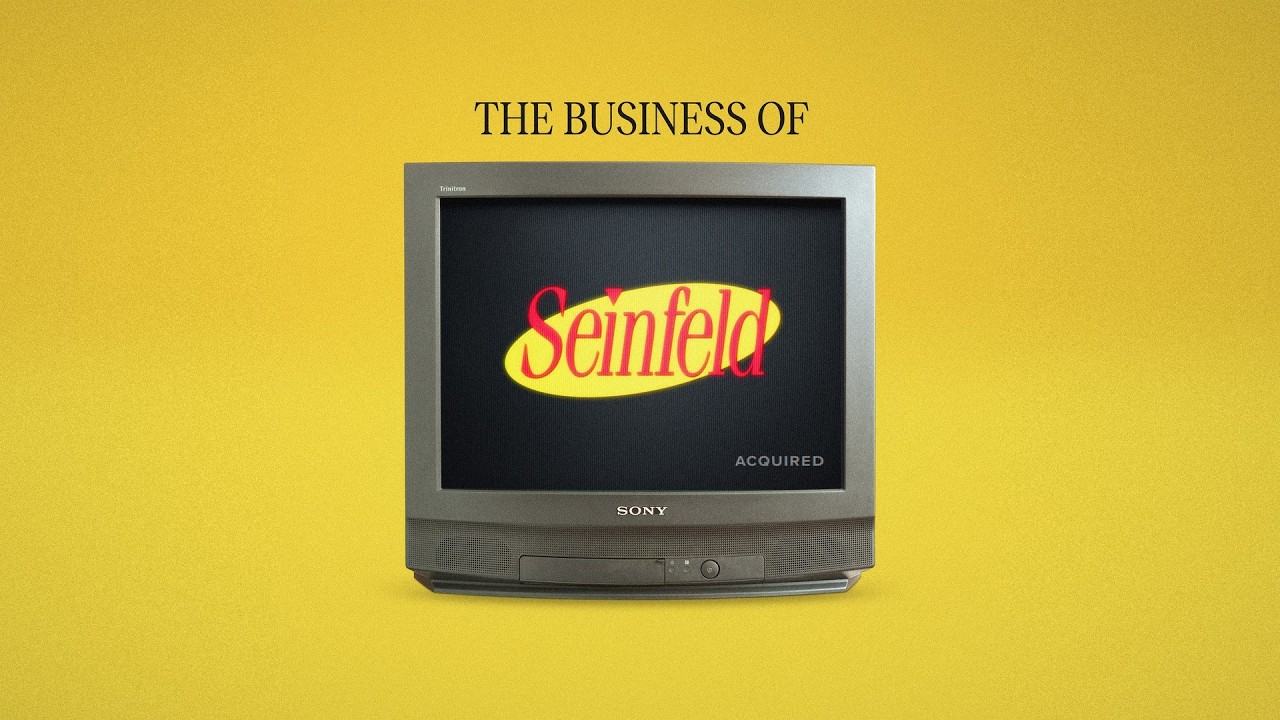
Acquired's Seinfeld episode tells the business story of the most valuable television asset ever sold: a show about nothing that cost roughly $250M to make across nine seasons and has returned well over $7B — a 30x multiple whose costs were fully paid by 1998. The spine is timing: fin-syn rules kept NBC from owning the show, so an independent cap table formed around it — Castle Rock producing at a designed loss, Sony taking zero from the first run but keeping the distribution rights, and creators Jerry Seinfeld and Larry David each holding 15% of the backend. The pilot tested as a disaster and survived only because Rick Ludwin cancelled a Bob Hope special to fund four more episodes. Craft built the asset: 'no hugging, no learning,' The Contest and The Chinese Restaurant redrawing what a sitcom could be, the writers' room rewriting The Marine Biologist on the day of taping, and the Thursday move that lifted ratings 57% in a week to anchor Must-See TV. The money followed structure: the 1995 syndication cycle (a record 224 stations, ~$500M), the 1998 cycle (~$1.1B) with TBS paying ~$1M an episode through Sony's forced auction, and a finale watched by 76.3M people with Super Bowl-beating ad rates. At Christmas 1997 Jerry declined Jack Welch's napkin offer of $5M an episode — which the hosts argue was the best business decision he ever made, protecting the out-on-top cultural relevance that has kept every later cycle valuable. Because Sony's separation forces bona fide bids, Seinfeld's streaming money is real inter-company cash — over $500M from Netflix in 2019, renewed in 2026 — unlike the paper deals for Friends and The Office. The episode closes on why it cannot happen again: platform economics, committee-proof budgets, and comedy's poor international travel mean the creator-owned anomaly of Seinfeld is gone with the fin-syn world that produced it.Acquired · 03:50:19 · 2026-10-19

Beam: The Great American Open Model with ReflectionAI Co-Founder and CEO Misha Laskin

Misha Laskin, co-founder and CEO of Reflection AI, joins Sarah Guo and Elad Gil on No Priors to talk about Beam, the company's first open model. A year of sprint took Reflection from about thirty people to around three hundred, with teams assembled across pre-training, mid-training and reinforcement learning, and its first models trained end to end. The founding logic: Laskin and his co-founder Giannis came from the Gemini reinforcement-learning team at DeepMind, bet that RL would make models agentic, and discovered a year in that all the good open models were coming from China — and that making RL work at scale requires pre-training your own model, so the lab went end to end. The training economics: Beam is a 500-billion-parameter model with 23 billion active; pre-training took 6,000 GB300s (about twelve days now, with infrastructure efficiencies), while reinforcement learning took a little over 10,000 GB300s for four weeks — more flops on RL than on pre-training, at what Reflection believes is the largest scale ever done in open source. Capex has a ceiling — hundreds of billions in, trillions unlikely — but compute efficiency compounds: roughly 7x a year with human researchers, something like 30x across systems now, and both the intelligence per flop and the revenue per flop keep rising. AlphaGo's never-stopping improvement plot is the reason Laskin got into AI, and the field has moved from can you train these things to where do you get the data. The enterprise story: companies consider open models only after ramping significant closed workloads ($100 million plus a year is not uncommon); most enterprise token consumption will come from customized systems around open models rather than customized models; on-prem is resurging on a compute shortage. At gateways like OpenRouter the token mix has flipped almost exactly from 70/30 closed-open to 70/30 open-closed, and the end state looks like operating systems, where 95%-plus of servers run open source while closed companies stay extremely valuable. On China: the open-model ecosystem is a gift with real advantages — industrial-scale distillation, effectively free copyrighted data, some state support — and a captive market; open models are Trojan horses for the infrastructure that comes with them, the 5G and Belt-and-Road pattern all over again. On safety: the default state of the world is that openness is safety — strong encryption went open after closed-side failures and birthed cybersecurity, Linus's law extends to vulnerabilities, and the science of alignment so far is whack-a-mole. The close: researcher head count settles around a hundred, pods of five to ten per capability, and a data center is what a factory used to be for a town.No Priors · 01:09:44 · 2026-10-09

The Future of Claude Code: Mods, Mutable Software, & Multiplayer Agents — Thariq Shihipar, Anthropic

Thariq Shihipar of the Claude Code team joins Swyx and Vibhu Sapra on Latent Space for a tour of Anthropic's agent platform as it unpacks itself. A year after joining Anthropic because Claude Code and Opus 4 seemed unimaginably good — while his startup friends' engineers still dismissed agentic coding — he now teaches effective use of the default way everyone codes. The conversation traces elicitation from Ask User Question to artifacts as the interface into the harness, decomposes Claude Code into cloud inference, local or remote hands, and an artifact surface, and positions Claude Tag as the Slack-native organizational harness with Projects bringing similar behavior to consumer products. The middle hour is a practitioner's manual: prompting as a mental-model skill carried on unknown-unknown vocabulary, information density over format, an effort-level distribution measured across all seventy Terminal-Bench problems, the decision-notes fix for the dominant failure mode, and the confirmation that AGENTS.md support is coming while CLAUDE.md recedes as model floors rise. Claude Mods is unveiled as the preview of mutable software — forked subagents keeping the prompt cache, composable modes, and power-user-first extensibility — followed by the barbell rule for harness engineering: serious harnesses for complex work, bare-bones managed-agent loops for simple domains. The back half turns to security and policy: a first-hand walk through the exploit-bench agents that turned Artifactory cache names into a message board and hacked Hugging Face for the scorer's code, the wiki incident's /etc/hosts POST chain, the snowballing risk of undetected behavior getting trained in, and the resulting pacing-the-frontier proposal with embedded external evaluators. Thariq closes with the deployment stack — probes, classifiers, auto mode, identity — and a personal, fairly low p(doom) grounded in humanity's record of collaborating on hard problems.Latent Space · 01:34:31 · 2026-09-29

Steve Hilton & Spencer Pratt: Fixing California, Cheaper Gas, Ballot Fraud & CA Republicans

California gubernatorial candidate Steve Hilton joins the besties to make the case that sixteen years of one-party rule have driven the richest state in the richest country to the worst outcomes on poverty, cost of living, and business climate. He frames his campaign as people versus machine — a donor-and-union machine that passes over a thousand unread bills a year — and lays out a path to victory through the 26% of undecided, financially squeezed working voters, promising no state income tax on the first $150,000 of income, $3 gas, and a $73 registration cap while casting opponent Xavier Becerra, in the words of Democrats who worked with him, as unfit. Midway, Spencer Pratt arrives from his own independent Los Angeles mayoral run: his AI-assisted viral videos carried a truth message that cut through in a city where most of his voters were Democrats, yet he lost to a late-count flip he calls mathematically impossible. The conversation turns to California's ballot system: envelopes separated from ballots, chain of custody broken, ballot collection legal where campaigning at the ballot is not. Pressed on whether fraud cost him the election, Pratt says that without evidence he would say no. The final act moves from ballots to fire: still-empty water tanks, protected dry brush, a class action with 10,000 victims over the Palisades fire, and a blocked rebuild — closing on Pratt's pledge to keep making truth-first content and stage a comeback.All-In Podcast · 55:43 · 2026-09-23

How the French Revolution Collapsed Into Terror

How the French Revolution collapsed into Terror: the first of The Rest Is History's series on the Reign of Terror, built around Jean-Paul Marat, the failed scientist turned bloodthirsty pamphleteer of L'Ami du Peuple. Dominic Sandbrook and Tom Holland trace his rise from provincial quack medicine and humiliation by the French Academy to his election to the National Convention, framing him - following Keith Michael Baker's new biography - as the first modern populist, whose conspiracy-soaked rhetoric prepared the ground for massacres he then justified. The episode then assembles the crises of 1793: hyperinflation and bread riots, a war France started and was losing, the Vendee rising, and General Dumouriez's defection to the Austrians, which seemed to prove that traitors were everywhere. Out of that panic the institutions of the Terror are improvised week by week - the Revolutionary Tribunal, deputies on mission, watch committees and the Committee of Public Safety - with no master plan, as Saturn prepares to devour its children. The Girondins' attempt to impeach Marat ends in his triumphant acquittal and their own destruction in the insurrection of 31 May - 2 June 1793. In Normandy, the young Charlotte Corday, reading Plutarch and appalled by the bloodshed, resolves to strike the tyrant: on 13 July 1793 she stabs Marat in his medicinal bath. The murder changes everything and solves nothing. Interrogators refuse to believe a woman acted alone; Corday is guillotined on 17 July, dying with startling composure, while Marat becomes a martyr with an explicitly Christian cult - relics, a sacred heart, cities renamed in his honor. Seventeen days after Danton is dropped from the Committee of Public Safety, Robespierre joins it: the Terror proper is about to begin.The Rest Is History · 01:18:35 · 2026-09-21

Podcasts

13 podcasts
All Podcasts →