
How Did the French Revolution Collapse Into the Reign of Terror?
Marat spent two failed decades chasing scientific recognition before 1789 let him reinvent himself as the revolutionary press's fiercest voice. The episode follows his rise and assassination, and asks the question his death poses: did killing him restrain the Revolution's violence, or push it further into the Terror?

Contents 9 sections
- Introduction
- A Modern Populist Before Populism Had a Name
- From the September Massacres to the Convention
- Collapse in the Provinces and at the Front
- Improvising the Machinery of Terror
- 2 June: The Convention Bows to the Street
- The Knife in the Bathtub
- "You're Crazy": The Lone Wolf Nobody Believed
- A Martyr Cult and the Embodiment of Terror
Introduction
On 13 July 1793 Charlotte Corday drove a kitchen knife into Jean-Paul Marat's chest as he worked from his medicinal bath, and the Revolution's most incendiary street fighter became its most useful corpse. The episode builds toward a deliberately uncomfortable answer to its central question: the assassination did not restrain the Revolution's violence — it fed the conspiracy thinking that justified the Terror. The warning had come four months earlier, when the great Girondin orator Vergniaud told the Convention that the revolutionaries "will be like Saturn, which devours its children, and all this will end in dictatorship."
A Modern Populist Before Populism Had a Name
Marat was born in 1743, the son of a Sardinian convert, and spent two failed decades chasing scientific recognition — a St Andrews diploma by correspondence, quack venereal cures, a claim to have overturned Newton — before 1789 let him reinvent himself as the editor of L'Ami du Peuple. Drawing on Keith Michael Baker's biography, the hosts frame him as the first modern populist: a betrayed "People", an obsession with conspiracy, a language of sleep and awakening, and contempt for politeness as a mark of betrayal. The ambition was lifelong and total: "At five years old I wanted to be a teacher, at 15 a professor, at 18 a writer, and at 20 a creative genius."
By 1793 his body was failing him. The disfiguring skin condition that kept him in the bath is identified on the episode as chronic herpetiform dermatitis, a diagnosis the host passes on without embellishment. In the martyr politics that followed, the ulcers themselves became credentials: proof that he suffered for the people as polished moderates did not.
From the September Massacres to the Convention
The distance between Marat's rhetoric and Marat's reality is the episode's first caution. In 1792, with Prussia advancing on Paris, he called on the sans-culottes to break into the prisons and destroy some 1,500 prisoners: "This is justice. It will restrain these legions of traitors." [Listen to the original · 11:03](https://www.youtube.com/watch?v=N3yVc7CDWYE&t=663s) Moderates outside Paris hated him — Peter McPhee's history records a club in Honfleur, Normandy, branding him a provocateur of murders — yet a week after the prison massacres Paris elected him to the National Convention.
Inside the Convention the split was sociological as much as ideological: Girondin merchants of Bordeaux and Lyon against Montagnard Paris, paternalist free-marketeers against deputies who saw violence as necessary, even healthy. Both wings read Rousseau; only one was willing to idealize the crowd.
Collapse in the Provinces and at the Front
The war the Girondins had championed was now lost on every front, and the levy of 300,000 men detonated the countryside. The Vendée's Catholic and Royal Army wore the Sacred Heart on its coats and answered Paris in its own idiom: "We are free people. We want our priests returned. If we must die, let them kill us in our own fields." The hosts note the metropolitan reflex — radicals dismissing peasant conservatism as priest-craft — and its recurrence in later revolutions.
Then General Dumouriez, the war's architect, was crushed at Neerwinden and defected to the Austrians with the future king Louis-Philippe among his officers. A volunteer's letter home gave the mood: "Who can we trust now? This Dumouriez, whom the French Republic considered its savior, dropped the mask." Only Marat, who had called him a traitor two weeks earlier, gained credit — precisely the credit that conspiracy thinking awards.
Improvising the Machinery of Terror
After the defection the Convention improvised the machinery of terror ad hoc, without a plan — the hosts insist on the improvisation, even as many builders would later be absorbed by what they built. Carnot gave the mood its charter: "Either we will crush them, or they will crush us. Any weakness will be fatal." The Revolutionary Tribunal, the commune-level committees of observation, the deputies on mission, and on 6 April the Committee of Public Safety — a Roman-style emergency dictatorship, renewed monthly. Danton, its early dominant figure, supplied the maxim: "Let's be terrible, so that the people don't have to be."
The Girondins' counterattack aimed at Marat himself, and rebounded. Tried on 24 April before a packed courtroom, he was acquitted within hours and carried out on shoulders, crowned with roses, a crowd chanting "Long live the Republic! Long live Marat!" The humiliation of the moderates was total, and their enemies in the clubs sharpened their knives.
2 June: The Convention Bows to the Street
May ended with the streets deciding who counted as the people. Hanriot's National Guard besieged the Convention with an ultimatum — deliver twenty-two Girondins within the hour "or we will all blow them up" — and cannon turned the deputies back inside. On 2 June the Convention voted the arrest of twenty-nine of its own members. Vergniaud, his own name on the list, answered with the episode's refrain: "Maybe I offer you a glass of blood to quench your thirst?"
Watching the resulting federalist mobilization from a Caen balcony stood the episode's second protagonist: Charlotte Corday, 24, of minor Norman nobility and descended from the playwright Corneille, convent-educated on Plutarch, Voltaire and Rousseau — a Girondin sympathizer, not a royalist, terrified by the slide into violence.
The Knife in the Bathtub
In Caen, Marat was the hate figure for proposing to crush the rebels "without mercy". The slogan quoted in Simon Schama's Citizens — "Let Marat's head fall, and the Republic will be saved" — troubles Tom Holland precisely because it reuses the logic of the king's trial: kill one man, save the Revolution.
Corday took that logic to its conclusion. Admitted to the sickroom on the pretext of naming Caen's traitors, she listened while Marat promised, of the eighteen names she gave him, "In a few days I will have them all guillotined" — and drove the knife into his chest.
"You're Crazy": The Lone Wolf Nobody Believed
The state could not believe its own explanation. Interrogators including Drouet of Varennes pressed her for the conspiracy behind the act; the Tribunal's president told her that someone must have lied to her about Marat. Her answer is the episode's sharpest line about political geography: "You're crazy. Only in Paris people are watching Marat. In other departments he is considered a monster." She was guillotined on 17 July, dying, all witnesses agreed, very well.
Marat's funeral completed the transposition. David staged it as a Roman martyrdom, and a club eulogist hailed the heart in its urn: "As Jesus, Marat passionately loved people... Their Jesus was only a false prophet, but Marat is a god."
A Martyr Cult and the Embodiment of Terror
The cult that followed was explicitly religious: relics, strands of hair for sale, Marat haircuts, cities renamed in his honor — Montmartre to Mont-Marat, Le Havre to Havre-Marat. For minds trained by four years of conspiracy talk, the murder was final proof that anyone might be a traitor; the imprisoned Girondins' fate was sealed, and everyone knew it.
Danton fell from favor — too secular, too pragmatic, too fond of deals — and was dropped from the Committee of Public Safety in his absence. Seventeen days later the member joined who would become the embodiment of the Terror: Maximilien Robespierre. The hosts close on the promise of the next episode: terror becomes the agenda, and the carts rumble to the guillotines in ever greater quantities.
Episode Booklist
3 books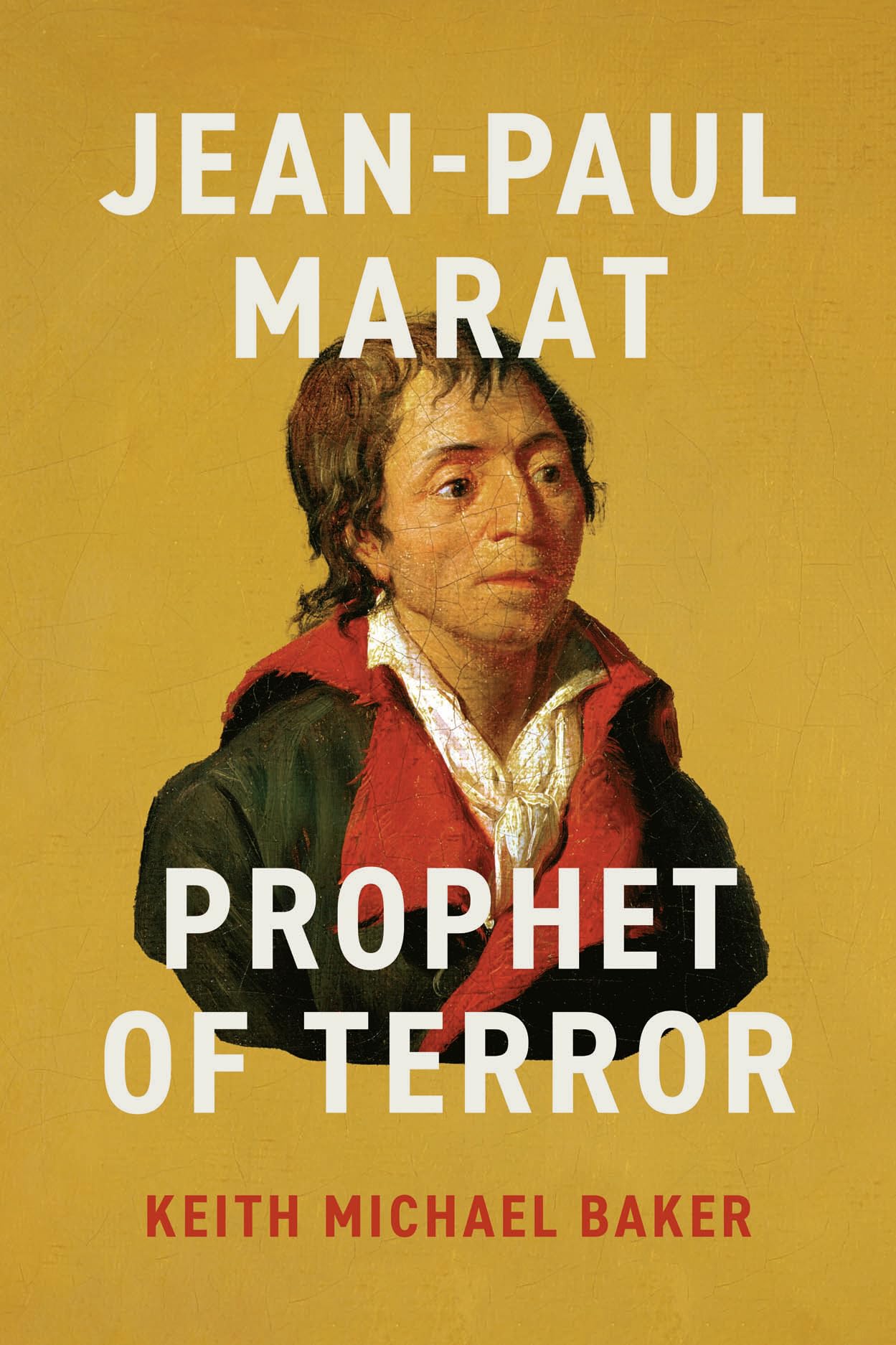 Marat: Prophet of Terror
WhyDominic recommends Baker's newly published biography of Marat as the current definitive life.05:33
 Liberty or Death: The French Revolution
WhyDominic draws on McPhee's history for provincial detail: a political club in Honfleur, Normandy.11:34
 Citizens: A Chronicle of the French Revolution
WhyDominic cites Schama's Citizens for a contemporary slogan demanding Marat's death as the Republic's salvation.54:40
Interview Highlights
3 exchanges- Q
Isn't that the stereotype about revolutionaries — people with enough academic education to feel they deserve a better society, and then don't get it?
Tom Holland asked03:55ADominic Sandbrook answeredThat's right — they spend ages down rabbit holes on YouTube; not idiots, but they feel rejected by great science or a great story.
- Q
So am I right in saying that when Rome encountered an existential threat, you appointed a Cincinnatus or someone from his plow, and he would take…” as dictator.
Dominic Sandbrook asked37:02ATom Holland answeredYes — for six months, a self-limited period; the dictator has full control of the state to end the emergency.
- Q
Therefore, Dominic, we heard before the break that the Girondins tried to condemn Marat to the Revolutionary Tribunal and suffered complete failure. Therefore, they shot. What now?
Tom Holland asked42:12ADominic Sandbrook answeredThe mood in the capital now is incredibly feverish. The paper money constantly loses its value; prices for bread grow. On 1 May, soon after Marat's acquittal, a bunch of working-class women intrudes on the Convention — the Society of Revolutionary Republican Women — one of many women's radical clubs.