
The Strait Closes Again: Iran's Deal Camp, the FT's Russia Timeline and the Ghost of Raisi
Introduction
Recorded as US-Iran military operations restart, this Duran episode is organized around one chokepoint and one question: who actually controls the Strait of Hormuz? Alexander Mercouris's headline judgment — the Strait of Hormuz is completely closed again as of recording, because without Iranian complicity nothing passes — sits against Alex Christoforou's dueling ship counts, Trump's daily Truth Social posts including the "Strait of Trump" rename, and a map of Tehran's factions that runs from the IRGC's confrontation camp to Pezeshkian's deal camp. Behind it all stands the ghost of Ebrahim Raisi — the president who took Iran into BRICS — and a Financial Times investigation the hosts treat as an intelligence-authored confirmation that Russia's military assistance to Iran began on his watch.
Dueling Ship Counts
Christoforou's opener sets the stakes: military operations between the United States and Iran have restarted, and both sides' strikes and retaliation are "focused and centered around control of the Strait of Hormuz." Trump posts about it just about daily on Truth Social — even floating a name change to the "Strait of Trump" — and the claims about what is actually getting through the strait could not differ more. The administration says 30 to 40 ships are getting out a night, against roughly 140 when it was fully open; the tracking services that watch the strait put the number at around 10, "give or take."
Mercouris's reading cuts through the numbers: certainly some ships have been getting through — on the southern route, as Christoforou interjects, the very route the administration says is being used. "I cannot imagine that this has been going on without the Iranians knowing about it and without the Iranians in some way green-lighting it." Whatever is moving is moving with a Persian green light.
Two Camps in Tehran
The episode's core is a faction map. On one side, the hardliners — "people mainly perhaps concentrated within the IRGC, but also in other agencies" — who want the Strait kept "completely closed" as leverage over the Americans and whose barely concealed objective is to get the Americans to "remove themselves completely from the entire Persian Gulf area of the Middle East."
On the other, President Masoud Pezeshkian — the politician responsible for an economy "going through very tough times": very high inflation, budget deficits, falling incomes. He recently made the case in a speech that this is the moment to end the war — "Iran is ahead on points", the political system intact, make the deal while strong — and what he wants is a "return to something like the memorandum of understanding, the MOU," with the Strait's reopening part of the deal. The speaker of the Iranian Parliament, Ghalibaf, shares the view, and sympathizers reach into the system's marrow: "Some of them might even be found within the IRGC." Eighteen days after this recording, Pezeshkian was still making exactly this case — telling Fox News Iran remained willing to move forward with the agreement reached with Trump (Iran International, September 24).
The Arrangement That Collapsed
How did the strait close again? Mercouris reconstructs the mechanism. There was an informal arrangement: "the Omanis are letting ships go through the Strait of Hormuz", and the Iranian side's argument was to "look the other way as that happens", then gradually move "towards some kind of return to the MOU" and a long-term agreement with the Americans.
Then Donald Trump, "as so often, couldn't restrain himself." He took to Truth Social to declare that "the United States controls the Strait of Hormuz", saying things that suggested he was "in no mood to make any kind of compromises." The result: "this informal arrangement that existed between the Americans and the Iranians fell apart" — "the hardliners in Tehran once again regained the ascendancy", ships in the Strait were struck, and the fighting in effect resumed. Hence the headline judgment: the strait is completely closed again. "It's as simple as that."
Christoforou's pushback frames the deal camp's dilemma: the MOU "was not realistic. Was not workable" — the US especially wanted nothing to do with it — "and Israel is never going to allow the US to agree to that type of deal either."
The American Frame
Mercouris locates the deeper problem: "the entire discussion is exclusively centered around the United States." For too many in Iran's policy machinery the question reduces to whether you can achieve peace with the Americans to rebuild the economy, or must fight them and "accept decades of hardship until you win." And "there are relatively few people within the upper reaches of the political system" prepared to think of alternatives — "developing BRICS, strengthening relations with China, building stronger relations with Russia."
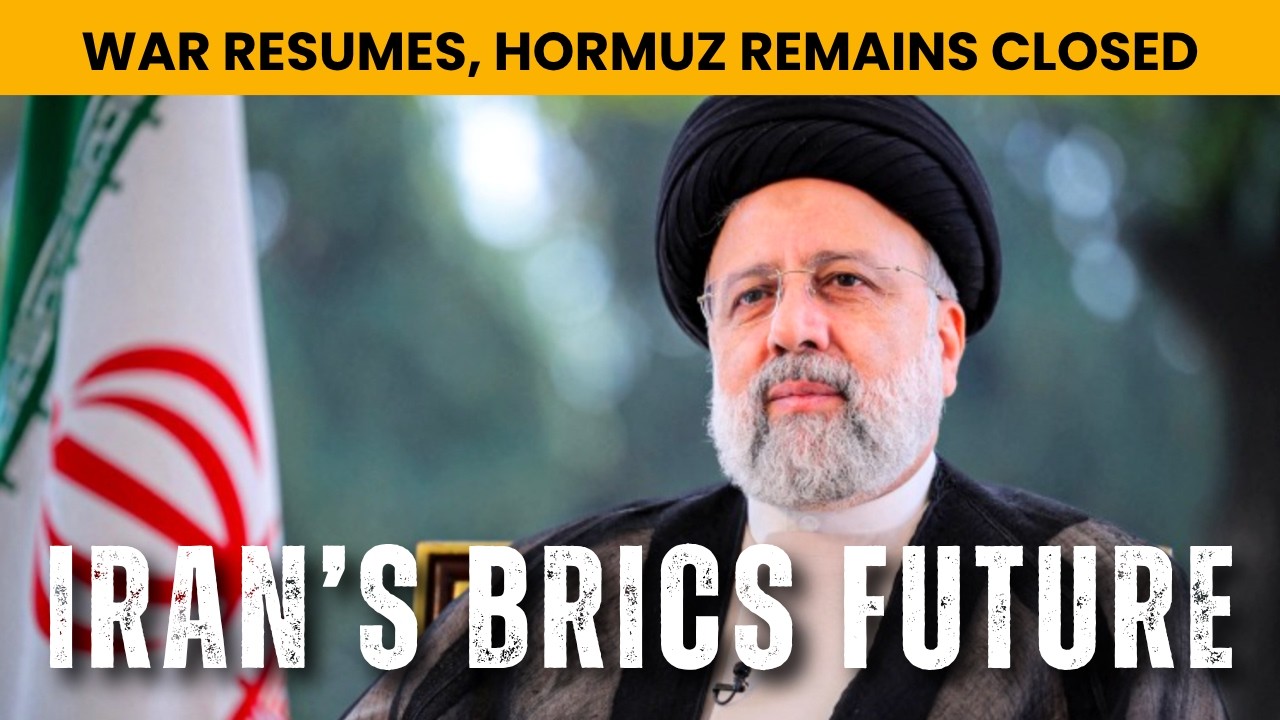
The counterexample is the previous president, Ebrahim Raisi: "he brought Iran into BRICS", with close relations with the Chinese and the Russians, and growing information shows "military contacts between the Russians and the Iranians began to grow and even burgeon" during his time. Then he "died in a helicopter accident, the nature of which has never been fully clarified" — and in his absence the entire discussion reverted, as if by default, to the American question. "Nobody looking for alternatives instead."
No Path to Military Victory
On the hardliners' own terms, can Iran win? "Ultimately, probably not." The IRGC and Iran can "wreak devastation across the Middle East" — pipelines, energy facilities, desalination plants, a massive humanitarian crisis — "but ultimately, the United States is a superpower and Iran is not." The hosts' own early-war prediction that a war past a week would swing the pendulum toward Iran "was proved right" — but an indefinite war of choice reverses it: "the pendulum of advantage is gradually going to shift in favor of the Americans", whose resources Iran alone cannot match. A long war of choice would be "a very reckless, a very risky approach."
Yet Mercouris concedes the hardliners' premise: "the hardliners are absolutely right that you cannot trust the Americans" and cannot make long-term deals with them. Which is his bridge: Iran has "other options that don't involve the United States" — and the Iranians don't seem interested, with Pezeshkian focused on the Americans "to an extremely unhealthy degree."
Hormuz Is the Key — and the Salesman in Chief
Christoforou supplies the economic engine of the whole war: "it holds the key to this entire war." If the US can get ships through — exert some control over the economic indicators — then the price of oil, the interest rates and the wider risk stay low: the things that would otherwise lead to American retreat and defeat all hang on getting ships through, "or even to make it appear as if ships are going through."
Hence the salesman: "Trump... can take one ship and turn it into 30 or 40" — only one may be crossing, he says forty, and parts of the public, the financial institutions and the market will believe him, so the price of oil stays down and everything stays moderated — "which is what Trump and Vance are trying to do." Iran's mirror-image logic: "they have to keep Hormuz closed in order to inflict pain" on the US and the global economy until America retreats. "That's what this is all about right now."
Mercouris's rejoinder turns the key over: the "wiser game, a wiser long-term game for Iran" is to play a different game altogether — because Hormuz's leverage "in effect traps Iran in a confrontation with the United States."
The FT's Timeline and the Raisi Legacy
Then the episode's evidentiary centerpiece: "there's been this very interesting article in the Financial Times, which by the way I take completely seriously." Mercouris can tell the difference between an article "completely spun out of nothing" and one based on real information "provided to the Financial Times by a Western intelligence agency" — and this one confirms what both hosts have privately heard: "the Russians have been providing Iran with technical assistance" and all kinds of military assistance to build up Iran's defenses. "That is real." The FT's reporting bears the hosts' reading out: programme C430L, Russian engineers advising on a supersonic cruise missile, described as one of the most significant known transfers of strategic military technology from Moscow to Tehran (corroborating the assistance claim).
And the timeline: "it all goes back to the period when Raisi was Iran's president. That's when it really started." The conclusion is delivered flat — "That's why they took him out." The FT dates the programme to 2023, with the contract signed in November 2023 — squarely inside Raisi's term (corroborating the Raisi-era reading). On air the connection becomes legacy: because of Raisi's connections "food and gas comes from the north"; other connections mean China and other BRICS states "might actually help Iran stabilize its financial system"; probably because of his role Iran "improved the technology of its ballistic missiles" and its drones. But Iran is "resting on the benefits of Raisi's policies without actually building on them" — back inside the false choice of a US deal or indefinite war. "That's a false choice."
A Minsk Deal for Tehran
Christoforou's closing ask: "I wonder if there's a middle ground for Iran" — a deal with the United States made "understanding that the deal is going to be broken", which buys the time to build up for the conflict both sides know is coming "in 5 years or 10 years." In a way, "a Minsk type of deal" — the one Angela Merkel "let everybody know" was about giving Ukraine time to build its military, while the Russian counter-argument holds "what Minsk gave Putin and his administration" was time to prepare the economy for the sanctions that eventually hit.
Mercouris's verdict: "I think that is a coherent and intelligent policy." But "you must prepare the ground for it carefully" — and right now the Russians and "even more the Chinese are very wary of having anything to do with the Iranians." So the prescription: "you should be going to China, you should be going to Moscow" and explaining — we know any deal with the Americans won't be honored; five years is too long; "a year, at most, is what I would guess"; we need time and help — do we have your support? The quiet-contacts version already exists — Pezeshkian was at the BRICS summit in Bishkek, met Xi Jinping and Putin — but "quiet, private contacts, in my experience of diplomacy, are never enough." "The leaders, the top leaders, need to be involved", in a constant flow from Tehran — cabinet, and "the military people should be going too." "And at the moment, I just don't see that."
Interview Highlights
4 exchanges- Q
Who really controls the Strait of Hormuz — and why did the fighting restart?
Alex Christoforou asked00:00AAlexander Mercouris answeredSome ships have been getting through — but Mercouris cannot imagine that happening without the Iranians knowing and in some way green-lighting it. Iran's factions: the hardliners, concentrated in the IRGC, want confrontation, want the Strait kept completely closed as leverage, and hardly conceal their objective of pushing the Americans out of the Persian Gulf entirely. Pezeshkian, the president, owns the economy — very high inflation, budget deficits, falling incomes — and has just said this is a good moment to end the war: Iran is ahead on points, the political system is intact, make the deal while strong. He wants a return to something like the MOU, and parliamentary speaker Ghalibaf shares the view; sympathizers exist even in the military and possibly within the IRGC. Hence the informal arrangement — the Omanis letting ships through on the southern route, Iranians looking the other way — until Trump could not restrain himself, posted that the United States controls the Strait and signaled no mood for compromise. The arrangement fell apart, hardliners in Tehran regained the ascendancy, ships in the Strait were struck, the fighting in effect resumed — and as of this recording the Strait of Hormuz is completely closed again: without some degree of Iranian complicity, no ship can pass. It is as simple as that.
- Q
Why can't Iran's leadership see any option that isn't the United States?
Alex Christoforou asked06:44AAlexander Mercouris answeredThe fundamental problem is that the entire discussion is exclusively centered on the United States — for far too many people in the Iranian policy-making machinery it reduces to whether you can achieve peace with the Americans so you can rebuild the economy, or whether you have to fight them and accept decades of hardship until you win. Relatively few people in the upper reaches of Iran's political system are prepared to think of alternatives: developing BRICS, strengthening relations with China, building stronger relations with Russia. The previous president, Ebrahim Raisi, did think in those ways — he brought Iran into BRICS, had close relations with the Chinese and the Russians, and growing information shows military contacts between the Russians and the Iranians began to grow and even burgeon during his time. Then he died in a helicopter accident, the nature of which has never been fully clarified — and in his absence, unfortunately, the entire discussion within Iran has reverted, as if by default, back to whether or not to make a deal with the Americans, nobody looking for alternatives instead.
- Q
Does Iran have a path to a military victory over the United States?
Alex Christoforou asked10:15AAlexander Mercouris answeredUltimately, probably not. The IRGC and Iran can wreak devastation across the Middle East — destroy all the pipelines, the energy facilities, the desalination plants, create a massive humanitarian crisis — but the United States is a superpower and Iran is not. In a war of that kind extended indefinitely, the pendulum of advantage gradually shifts in favor of the Americans, whose resources Iran by itself is simply unable to match. The earlier prediction — that a war lasting longer than a week would swing the pendulum toward Iran — proved right, but an indefinite war of choice reverses it. There are uncertainties — a US economic crisis, a policy change in Washington, exhaustion with the length of the Middle East commitment — but none of those is a plan, and a long war of choice would be very reckless. By contrast, the hardliners are absolutely right that you cannot trust the Americans and cannot make long-term deals with them — such deals will be broken and leave Iran in an enormous position of disadvantage. Which is exactly the point: Iran has other options that don't involve the United States, and the Iranians don't seem to be thinking about them or interested in taking them — Pezeshkian remains focused on the Americans to an extremely unhealthy degree.
- Q
Could a Minsk-style broken-deal buy Iran the time it needs?
Alex Christoforou asked19:32AAlexander Mercouris answeredThat middle ground — sign the deal knowing it will be broken, and use the time to build up for the conflict coming in 5 or 10 years — is, like Minsk (which Merkel said was about giving Ukraine time to build its military, and which on the Russian argument gave Putin time to prepare the economy for the sanctions that hit), a coherent and intelligent policy. But executing on it requires preparing the ground carefully, and at the moment the Russians and even more the Chinese are very wary of having anything to do with the Iranians. What Tehran should be doing is sending the president, the prime minister, the entire cabinet and the military people constantly to Beijing, Moscow and the like, explaining: we know any deal we make with the Americans is not going to be honored; we don't have five years — the Americans and the Israelis won't wait; a year at most; we need time and help — do we have your support? Quiet, private contacts — Pezeshkian meeting Xi Jinping and Putin at the BRICS summit in Bishkek — are in Mercouris's experience of diplomacy never enough; the top leaders need to be involved, in a constant flow from Tehran. At the moment, he just doesn't see it.