
What Does Sustainable Work With Coding Agents Look Like?
On Syntax, the hosts put numbers on healthy AI usage — most employers cover $200–$500 a month, $200 subscriptions beat enterprise token billing, and Wes metered $1,100 of weekly tokens on his — then add the guardrails, the wait-time discipline, and the honest answer to lost motivation.
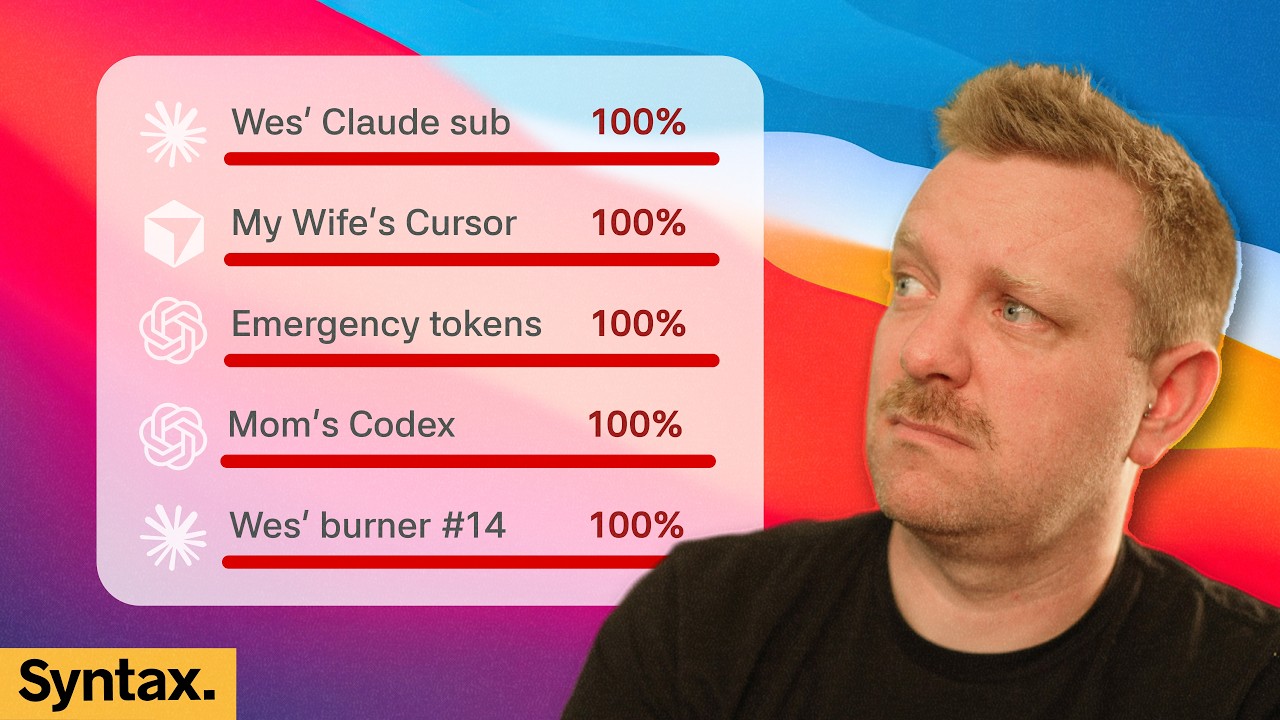
What does sustainable work with coding agents look like?
On this Syntax potluck, the hosts sketch a working style with four load-bearing parts: a real budget with a scale-up path, deterministic guardrails instead of vigilance, wait time converted into specifications, and — the part nobody budgets for — moving your own job satisfaction up a layer when the code stops being yours. Scott Tolinski opens by dismissing five-maxed-subscriptions bragging as performative. The number that actually matters to employers, from Wes Bos's polling: the overwhelming majority of companies now land between $200 and $500 a month of covered AI use. And the number that matters to developers: his own usage tracker showed $1,100 of tokens in one week — a fraction of what that would cost at enterprise rates. The rest of the episode is about spending that gap well.
$200–$500 a month, and why the subscriptions win
Wes's snapshot of employer behavior after the first year of agent hype: a handful of companies are unlimited, some fund one subscription, some fund several burned in sequence — and enterprise token billing from the big vendors is, in his words, not as good a deal as the $200-a-month subscription. The discipline argument cuts both ways. A developer shipping features could easily spend a thousand dollars a day, and he has DMs from people with $15,000-a-month access — so restraint is a skill, best practiced through a limited budget with an approval path for real campaigns ("we're rewriting in Rust; I need twenty grand of tokens"). The $1,100 weekly reading on $200-ish of subscriptions is the whole pitch: if the company pays for one, take it.
Turn wait time into specification time
What do you do while the agent runs? Scott's confession first: another agent, then another, until your brain fries. His actual practice is better: he runs an orchestrator agent plus a cheap model whose only job is filing GitHub issues from his brain-dumped complaints about the UI. Documenting what is wrong — researching the design patterns, distilling the fix — takes longer than an agent turn, so every wait produces backlog instead of idle, and the next pickup starts from a real specification instead of "make the UI better, more modern."
Guardrails, not vigilance
Asked how you keep an agent from going off the rails, Scott's answer is a stack of deterministic controls. A hook can ask whether the agent is trying to do an rm, block it, and hand back "do this instead." When an agent once responded to a dead Jellyfin by spinning up an unrequested replacement container, he wired a status-check automation so agents now get state and instructions before improvising. His linters and tests include agent-browser frame-rate checks that fail below roughly 55 fps, because feature creep lags the UI silently. And following their producer CJ's advice, isolation and containers bound whatever still goes wrong. Steering, the follow-up topic, gets harness-specific verdicts: Scott almost always stops the run, because by-the-way injections arrive too late when they matter; Wes notes OpenCode effectively has no steering at all, while Codex's queue-for-next-turn is the current best.
The motivation problem, honestly
The hardest question in the episode is personal: a developer who loved weekend learning now cannot touch a computer. Scott does not wave it away: AI coding is like Game Genie — the cheats entertain for about five minutes, and then the challenge is simply gone. His working answer is a reframe: find the joy in strategy, in deep UI refinement, in improving your own process and harness — so that the code becomes a result of the improvement of my process rather than an improvement of the code by my hands directly.
Everything here expires
The closing warning applies to all of it. Wes: of everything they learned about agent tooling in the last eight months, so much of it does not even matter anymore — he now doubts they still need a docs MCP that was standard equipment months ago, because plain search got good. And Scott adds that most installed skills just add unnecessary token churn. The sustainable posture is not a stack you adopt; it is a budget you cap, guardrails you own, specifications you write while waiting, and a habit of auditing which pieces still earn their keep.
Interview Highlights
10 exchanges- Q
What is the modern-day equivalent of blogging for developers and designers who want to stand out?
Scott Tolinski asked01:36AScott Tolinski, Wes Bos answeredBoth hosts answer: opinions are the new differentiator. Scott says audiences now reward people who took the time to figure something out and formed a view, not the high-level demo; distilling real experience cohesively is what promotes a person. Blogs still work — Hacker News is still mostly text — and short-form video is worth practicing, but Wes's summary is that 'yapping is the new blogging'. Wes adds that the barrier is now authenticity: AI-fakeable output (slop GitHub repos, formulaic YouTube takes) is discounted, while human, traceable work — like a Netflix engineer he follows sharing his Hugging Face rebuild bit by bit on Twitter with text and photos — is exactly what would put someone at the top of his hiring list. Their closing advice: do interesting things, put them out there, and let the opinions stand out to employers.
- Q
What should you do while your coding agent runs for minutes at a time?
Scott Tolinski asked08:33AScott Tolinski, Wes Bos answeredScott's honest answer: he puts another agent on a different task, then another, until 'your brain fries' — while noting push-ups or a walk would probably be better. Wes prefers tighter loops: an agent running ten minutes already annoys him, and even two-to-three-minute waits break flow, which is why people say the flow state is gone. Scott's actual method for the wait: inspect the application and write down, in detail, everything wrong with the UI. He runs an orchestrator agent plus a cheap 'GitHub issue' agent, brain-dumps problems into issues while the orchestrator works, and finds that documenting what needs fixing — researching design patterns and distilling them — takes longer than a single agent turn and builds a backlog so the next pickup is never 'make the UI better, more modern'. Wes frames the underlying shift: AI coding is refining a statue that starts close to done, so that process needs the eye and intent to refine.
- Q
How much should an employer cover for employee AI usage, and how do budgets actually look?
Scott Tolinski asked14:01AWes Bos answeredWes reports that company stances changed in the last six months: after the 'magic box, prompt forever' phase produced runaway spend, slop, review load, and security issues, most employers he polled on Twitter now land between $200 and $500 a month — a handful unlimited, some $200 for one sub, some $500 covering several subs that people burn through in sequence — while enterprise token billing at Anthropic and Claude-scale vendors is a much worse deal than the $200 subscriptions. He treats budgeting as a skill developers must now learn, like performance tuning once was: you can easily spend a thousand dollars a day building features, so restraint matters, and a limited budget with the ability to scale up — 'boss, we're rewriting in Rust, I need 20 grand of tokens' — is the sane pattern. He tracks his own usage with a Mac app, Codex Bar, wired to all his subscriptions; it showed $1,100 of tokens in a week he did not pay $1,100 for, which is why he calls the $200 subs by far the best deal — get one if your company pays.
- Q
How should you build the transactional emails your app sends in 2026?
Scott Tolinski asked20:31AScott Tolinski, Wes Bos answeredScott always rolls his own templates — trivial in the agent era — unless the platform (he names PocketBase) builds them in; his pain point is cost, since he hates paying for occasional transactional email, and he currently sends through Resend's API while eyeing Postmark (free at 100 emails a month) and Amazon SES's pay-per-email for low-volume side projects. Wes's stack is React's render-to-string with inlined CSS for reusable templates, sent over plain SMTP through any provider like SendGrid, precisely so no single company owns his pipeline. Both converge on the portability rule: always send through standard APIs or SMTP, because deliverability is fragile — if 2% of mail suddenly lands in spam, that is real lost revenue, which is why Resend is such a big company — and a standards-based sender can swap providers the moment it happens.
- Q
How do you keep a coding agent from going off the rails — and would you say it can be done reliably?
Scott Tolinski asked25:26AScott Tolinski, Wes Bos answeredScott's mechanism list: harness hooks like Claude Code's can deterministically intercept a dangerous call — detect an rm attempt, block it, and tell the agent what to do instead — plus deny lists, linters, and tests; he wrote frame-rate tests that spin up an agent browser after each implemented feature and fail under about 55 fps. For routing he uses deterministic automations: when he asked an agent why his Jellyfin was down and it spun up an unrequested replacement container, he wired a status-check automation so the agent now gets state plus instructions instead of improvising. Rules in agents.md ('don't write fallbacks for absolutely everything') curb feature bloat, isolation and containers bound the blast radius (their producer CJ's recommendation), and Wes adds the human habit: he watches the output and spams escape the moment the agent wanders. Scott's caveat answers the interview question: there are still times the agent does what it wants, so if it derails constantly, that is on you — you are yoloing the prompts too much and need to stay closer.
- Q
What is the best way to steer a coding agent mid-run — stop it, queue a message, or use by-the-way features?
Wes Bos asked30:25AScott Tolinski answeredScott has not found a steering pattern he loves. He dislikes by-the-way features — that queued turn often takes too long — and his rule is that stepping in is usually urgent, so he defaults to stopping the run regardless. The one exception he names is Claude Code, which he lets pick up mid-run because it handles the injection particularly well; even then he does not mind hitting stop, since the agent usually is not doing damage and the next turn, twenty or thirty seconds away, is a fine place to add context or change course. Wes closes unsatisfied but decisive: none of them are great, and Codex's queue-next-turn behavior is his favorite so far.
- Q
How do you get engineers interested in agentic development when interest on the team is low?
Scott Tolinski asked32:48AScott Tolinski, Wes Bos answeredScott warns that some engineers carry an ideological anger toward AI tooling and will not be moved, and that many resisters have not registered how much better the models have become; the 'look at this crazy one-prompt thing' demo actively hurts. What works instead: lunch-and-learn sessions showing real workflows — how it improves your development flow and your code — rather than stunts; relating to the person, since this is a people problem about the wall they have built. Wes adds that leadership must visibly share how they themselves use the tool, ideally in a company Slack channel like Sentry's, where top engineers trade questions, criticism, and tips; he loves that channel. Scott's last suggestion is internal screen recordings of an actual debugging process — the bug, the steps, the benefit at the other end — even if that format does poorly publicly.
- Q
What interface will non-coding AI agents get — Telegram-style chat, chat super-apps, or purpose-built UIs?
Scott Tolinski asked35:52AScott Tolinski, Wes Bos answeredScott says everyone is hunting the golden-goose UI right now. Codex has merged into ChatGPT as one app, and the two big general-purpose agents he names — Grokbot and Facebook's Muse — are chat applications with few knobs, aimed at daily tasks rather than coding. His read: plain Telegram back-and-forth is probably not it, because you need somewhat more control over the UI — but not so much that it overwhelms, which is why Grokbot and Muse lean chat-heavy. Wes testifies from the custom end: his own purpose-built setup is great when it works but 'breaks all the gosh darn time' and earns a weekly 'the AI is not working again' message from his wife; third-party options like the Hermes desktop app are really good, though. Scott's position lands in between: he still runs his custom one, and it is kind of annoying.
- Q
How do you stay motivated to code when AI has drained the excitement from it?
Scott Tolinski asked38:43AScott Tolinski answeredScott answers from his own struggle: AI coding is like playing a game with Game Genie — the cheats are fun for five minutes, and then the challenge is gone, and coding's deep digging is exactly the part you lose when the workflow becomes 'agent, fix this'. He also acknowledges AI coding is more exhausting for other reasons — broken flow and what their listener mental-health survey surfaced. What restored his drive was moving up a layer: finding the joy in strategy, deep UI refinement, and larger structures and architectures — and in improving his own process, harness, and skills, so that the code becomes a result of an improved process rather than something improved by his hands directly. Wes's whole reply: 'I agree. Well put.'
- Q
Should a company build its own all-in-one AI harness, or keep humans as the orchestrator with small per-problem agents?
Scott Tolinski asked44:16AScott Tolinski, Wes Bos answeredScott grants that harnesses are genuinely hard — caching, model routing, efficiency — which is why harness experts exist. But he has never considered rolling his own despite his build-it-yourself instincts: custom tooling around a harness makes sense, building the harness itself does not. His verdict on B Murf's either/or: the answer is in the middle — the company went left, the listener went right, and sadly the truth is between the monolithic harness and human-orchestrated micro-agents. Wes's addendum undercuts the shelf life of any answer: much of what they learned in the last eight months already does not matter — he now doubts they still need the Context7 MCP for docs because search got so good — and Scott seconds it with his 3D-printable rendering story (a library that collapsed a year ago now works), adding that installed skills often just add token churn, so audit which pieces actually help.