
Why Are NFL Teams So Valuable? The Product Is Competitive Uncertainty
The NFL's value did not come from letting its best teams dominate. Predictable games emptied stadiums, so the league adopted reverse-order drafting, schedule design, and shared gate revenue to keep any team able to beat any other. Competitive uncertainty, sold collectively, became the product that made small-town teams valuable.

Introduction
The NFL's rise is often told as a story about America's love of football. In Ben Gilbert and David Rosenthal's account, that explanation misses the operating system. The league became dominant because owners repeatedly limited what any one club could keep or control. They treated competitive uncertainty, national distribution, and shared economics as products that had to be designed.
A dominant team can weaken its own league
The postwar AAFC supplied an early warning. Paul Brown's Cleveland team won relentlessly, but predictable games reduced the reason for opposing fans to attend. Bert Bell's response became the league's governing idea: on any given Sunday, any team should be able to beat another. Reverse-order drafting, schedule design, and shared gate revenue were not simply fairness policies. They were demand-management tools. [n01]
That principle required owners to accept an unusual bargain. A stronger individual club could not be allowed to make the league's weekly inventory less compelling. The hosts compress the bargain into four words: "League first, team second." [n02]
Television rewarded the collective bargain
Pete Rozelle understood that local television deals reproduced the same imbalance. A national package could create one coherent product and spread its value across markets. The Sports Broadcasting Act allowed collective negotiation; NFL Films gave the product a visual memory; centralized merchandising made the league's identity portable.
The AFL merger and the Super Bowl then turned competition between organizations into a larger shared spectacle. When Joe Namath's Jets upset the Colts, an NFL owner lost the game, but the merged league gained proof that its championship was genuinely uncertain. The field result mattered because it made the next field result more valuable. [n03]
Monday night changed what a game could be
ABC and Roone Arledge concentrated resources on one weekly prime-time game. Field-level cameras, more camera positions, a three-person booth, parabolic microphones, graphics, music, sideline interviews, and NFL Films highlights made the broadcast feel like show business. The innovation was not merely better coverage. It created a national appointment that could be sold separately from the existing Sunday packages. [n04]
This became a repeatable commercial method: divide scarce live games into packages, invite distributors to compete, and let partners bear much of the production and customer-acquisition cost. The hosts argue that the NFL captures the resulting value because television networks and technology platforms have few substitutes capable of reaching a large cross-demographic audience at once. [n05]
The system also concentrates power
The same coordination has consequences beyond revenue. The episode discusses the league's delayed acknowledgment of long-term head-trauma risk and its treatment of Colin Kaepernick. The hosts state that the NFL blackballed him after his protest; that is their attributed assertion about a disputed controversy, not an independently verified conclusion here. [n06]
They also describe a widening economic tension. National media money is shared, but premium seating, sponsorship, and other local revenue vary sharply. A salary cap can preserve spending balance on the field while weak-market teams have much less money left for coaching, facilities, and the rest of the product. The league-first settlement therefore depends on more than equal player payrolls.
New distributors extend the model, and new capital tests it
The 2026 update presents Amazon, YouTube, Netflix, and ESPN streaming as additions to the bidder set and possible routes to international audiences. Legal sports betting, fantasy football, and the Taylor Swift crossover are discussed as attention multipliers. The numerical audience and economic effects remain episode claims requiring dated primary-source verification. [n07]
Private equity creates the final test. The Commanders sale exposed how strict ownership rules had narrowed the pool of buyers. The NFL admitted only approved firms, capped their stakes, denied control, and, according to the hosts, arranged to share part of eventual investment gains across owners. They interpret that design as another version of collective capitalism, while acknowledging that the exact legal mechanics are not known. [n08]
The NFL's most durable advantage is therefore not any team, player, network, or technology. It is the ability to make powerful owners accept limits when those limits increase the value of uncertainty. Rising franchise values suggest that bargain still works. The growing gap between the most and least profitable teams shows why it cannot be taken for granted.
Episode Booklist
1 book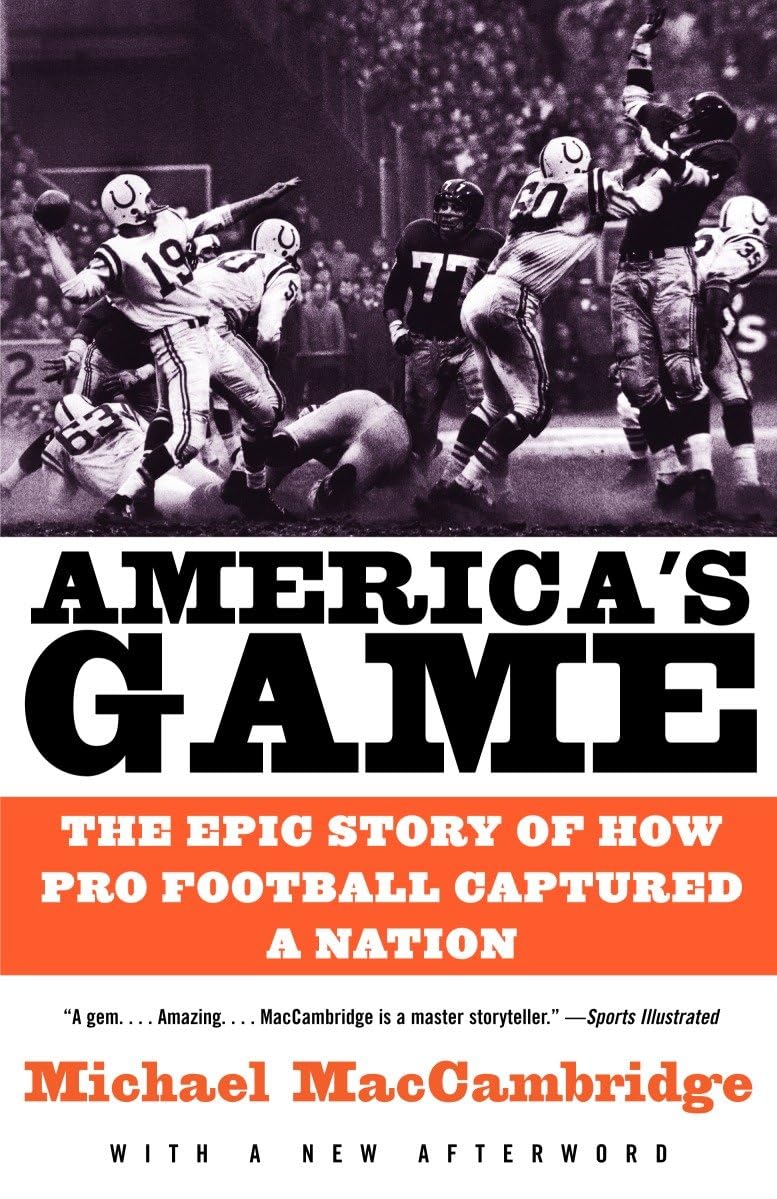 America's Game: The Epic Story of How Pro Football Captured a Nation
WhyThe hosts identify the book as a principal historical source for the episode.00:02