
Why Le Pen and Weidel Look Unstoppable, and What Tools the EU Still Has
Introduction
The Duran builds this episode around a collision: a French presidential election in 2027 that Macron cannot contest, a German opposition party whose leader claims three-to-one dominance in the East, and a European institution that, in the hosts' words, still has tools and intends to use them. None of the figures cited in the program has been independently verified for this article; what follows reconstructs the argument with its attribution and hedging left in place.
France After a Rigged Election
Alexander Mercouris's account of the last French parliamentary elections is that the Macronists and the leftists made a deal between themselves, leaving Le Pen's party convincingly ahead of everyone else yet still third in seats. The centrist government he had predicted then formed, with the Socialist wing of the left distancing itself from Mélenchon — and the consequence, in his reading, is a left shattered, probably beyond recovery, while Mélenchon remains its most popular figure.
That is the backdrop for his assessment of Le Pen: distrusted by many on the right, disliked in the center, and still, at this point, the only person in French politics worth taking seriously. In the polls for next year's presidential race she is, he says, about 20% ahead of her main competitor, whom he names as Mélenchon. The mechanism he describes is psychological: the longer she stays in front, the more the idea of her victory takes root — a process he compares to de Gaulle in the 1950s while expressly denying she is of that caliber. Today it is hard to imagine how she loses, he says; three months from now, he allows, everything may be different.
The institutional reply comes from Alex Christoforou in a single line: "Ursula has the tools, and she will use them." What those tools are is never specified. The sentence is a warning, not an analysis, and reads as the hosts' expectation of EU countermeasures against a Le Pen victory rather than a documented plan.
Between Orban and Meloni
Asked to place Le Pen on the program's spectrum — Meloni the complete globalist, Orban the anti-globalist — Mercouris answers that she leans a little more towards Orban, but without Orban's brilliance, strength of personality, erudition, or consistency of thinking. As a politician she has constantly dodged and changed position, he says; what matters is the force beneath her, a coalition of the French working class and, an important change, increasingly older voters who were traditionally her most hostile opponents.
There is also, he says, a durable current in French opinion that the country became too close to the Americans and the British under Macron, Sarkozy, and Hollande — Hollande, he notes, is thinking about running again, which he calls a strange idea — and more open skepticism in France about the Ukraine project than in Britain or the United States. As for a united European right, the hosts rule it out: Le Pen and Meloni, in their words, cannot stand each other — Christoforou offers the Greek word "misos" — after Meloni slammed the door on Le Pen's attempt at contact. Meloni, in their telling, has since become completely aligned with Ursula.
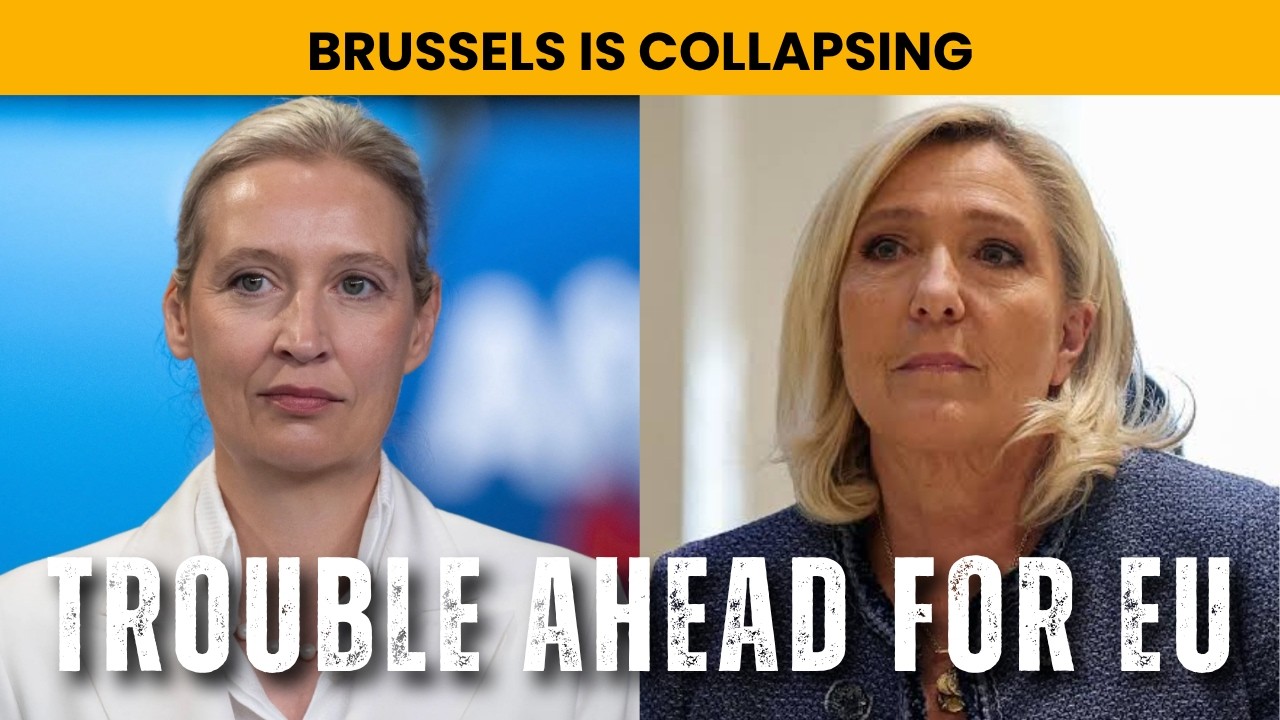
Then Germany. If Le Pen must be compared with anyone, Mercouris says, compare her with Alice Weidel: in his words, a much more talented political leader and a much stronger intellectual figure than Le Pen. The AfD, he says, is sweeping everything before it in East Germany, with first place predicted in the upcoming Saxony-Anhalt, Saxony, and Mecklenburg-Western Pomerania elections. The episode opened on the same surge — Weidel's post on X claiming about 43% support in East Germany, three times the CDU/CSU. One caveat the program itself supplies: minutes later the question is framed around "20% in East Germany," and neither figure is checked against a published poll.
The Ground in Germany and the Fortress in Brussels
The most vivid passages are first-hand. In Mainz, a city he knows well, Mercouris says he saw homeless people in the main square — something, he says, that did not exist in Germany ten years ago and would have been unthinkable twenty years ago — alongside closing businesses and what he calls obvious signs of economic disaster. The hostility to the AfD he remembered in West Germany is, in his account, no longer there; nobody he spoke to said a single good word about Chancellor Merz. His summation: the AfD is by far the strongest party in Germany at the moment, with the SPD and CDU not at all prepared to confront it, though he stops short of calling its rise inevitable.
Brussels, where he spent two days, receives the harshest treatment: a center declining into a poor, increasingly run-down version of a third-world city, around an EU quarter whose main building carries a top-to-bottom banner reading "This is democracy." "What we protect." The endless construction around the buildings is, in his reading, designed to change the architecture of streets and squares to prevent large protests, producing fortress buildings. Belgium's leaders, he argues, live in a bubble, an increasingly fortified bubble, with deep contempt for the people around them; the huge corruption he alleges around the construction is attributed to an unnamed Commission employee. The closing contrast is a duel between two capitals — Moscow, a shining, ultra-modern, extremely efficient metropolis, against Brussels turning into a horrible slum.
The verification burden here is heavy, and the program does not carry it: the polling figures are relayed social-media claims, the German and Brussels material is one traveler's impressions, and the sharpest allegations rest on unnamed acquaintances. What the episode documents reliably is a frame — inevitability on one side, institutional self-protection on the other — not a set of established facts.
Interview Highlights
3 exchanges- Q
On the globalist spectrum, would you place Le Pen closer to Orban or to Meloni?
Alex Christoforou asked06:47AAlexander Mercouris answeredMercouris puts Le Pen closer to Orban than to Meloni, but without Orban's brilliance, strength of personality, or erudition, and without his consistency of thinking. He separates Le Pen as a political force from Le Pen as a politician: as a politician she has constantly dodged and changed her position. What pushes her toward Orban is her electoral coalition — the working class of France and, an important change, increasingly older voters, who were traditionally the most hostile to her and are now coming around to her side. That coalition will push her in a direction closer to Orban than to Meloni. On foreign policy, he says there has always been a view in France that the country became too close to the Americans and too close to the British under Macron, under Sarkozy, under Hollande.
- Q
Is the AfD really that serious a force, with its 20% support in East Germany?
Alex Christoforou asked11:17AAlexander Mercouris answeredMercouris thinks so, and says the more revealing comparison for Le Pen is Alice Weidel, whom he calls a much more talented political leader and a much stronger intellectual figure than Le Pen. The AfD is sweeping away everything in its path in East Germany, which has always been its main stronghold. He expects it to perform very strongly in the upcoming Saxony-Anhalt and Saxony elections and probably come in first, and says it will be first, he is sure, in Mecklenburg-Western Pomerania, which is also in East Germany.
- Q
Aren't the political leaders of Belgium and Brussels concerned about Brussels' decline?
Alex Christoforou asked20:23AAlexander Mercouris answeredMercouris argues they live in a bubble, an increasingly fortified one: they are well protected, are taking steps to protect themselves even more, and feel a deep contempt for the people around them — he does not think they have any love for the people of Brussels. Drawing on his own visits to the Commission since the 1990s, he says the people who worked there were always very disconnected from life in Belgium and Brussels, and that it has now reached a terrifying scale. A Commission employee told him the construction and redevelopment around the EU quarter seems to never end, and he says huge corruption is involved — beyond the scam around the Ukraine project there are other small deals in parallel.