
Why the Kremlin Slammed the Door on the Vatican, the CIA, and Ceasefire Talks
Introduction
Within days of each other, the Vatican's envoy and CIA director John Ratcliffe both landed in Moscow, and Foreign Minister Sergei Lavrov followed with public statements. On The Duran, both hosts read those statements as Russia formally closing the diplomatic chapter — and expect what comes next to be decided on the battlefields. Nothing said in the program has been independently verified for this article; what follows reconstructs the argument with its attribution and hedging left in place.
Two Visits, One Answer
Alex Christoforou set the scene: the Vatican in Moscow, Ratcliffe in Moscow, and now Lavrov's statements — more about the meeting with the Vatican official than with the CIA director. Alexander Mercouris's reading is that the two visits dovetailed by design: one provided the ethical push, the other the hardline push, both aimed at getting the Russians to stop. Lavrov's answer to both, as Mercouris reconstructs it from the statements: negotiations to settle the conflict were tried going all the way back to 2014, and goodwill is now gone because Western diplomacy is based on deception — the keyword, in Mercouris's telling. On the question of an ultimatum over US assistance in Ukrainian strikes, Lavrov said none was given, though the topic came up in every meeting. The consequence, per the hosts: negotiations can only run on trust, there is none, and the outcome will be military.
The Vatican envoy comes out no better: Lavrov said he offered no counterarguments — he was just basically telling Lavrov, "Come on, just agree to a ceasefire". Lula was enlisted too: he and Trump agreed there needed to be an immediate end to the fighting, and the Brazilian president has been pressing the Russians — the hosts see the deep state activating everybody, even BRICS members. But the door was slammed by the collective West onto Russia, in their phrase, and Lavrov's exact words on negotiations were "The end has come".
The Narrative Flips: Helping Putin
The hosts pair the diplomacy with a media story. Keith Kellogg said days ago that Ukraine is winning; Alexander Stubb said weeks ago that it has already won — so why, the hosts ask, is anyone begging for a ceasefire? Then comes the New York Times' new account of Ratcliffe's trip, which Christoforou relays: the narrative now is that Ratcliffe went to Moscow in order to help Putin — to deliver correct intelligence to a leader supposedly deceived by his own services, before Russia collapses. The Times' headline, read verbatim on air: "CIA chief delivered bleak assessment of Russia's war in secretive Moscow visit", with the meeting aimed at pushing the Kremlin toward a peace deal. One caveat this article adds: the Times piece is paywalled, so the verification here rests on that verbatim headline and dek, not the article body.
Mercouris's rejoinder has two parts. First, stripped of nonsense, the report corroborates The Duran's earlier analysis — the trip was about getting the Russians to stop. Second, the absurdity: Ratcliffe never actually met Putin — nor Lavrov; he met the intelligence people, Naryshkin and Bortnikov, the very people supposedly deceiving Putin. The West, he argues, is trying to persuade a government it sought to overthrow — which knows it — to stop while it holds overwhelming advantage. Since when has the CIA held out a helping hand to the Russians? he asks.
The Ring Tightens Around the Fortified Towns
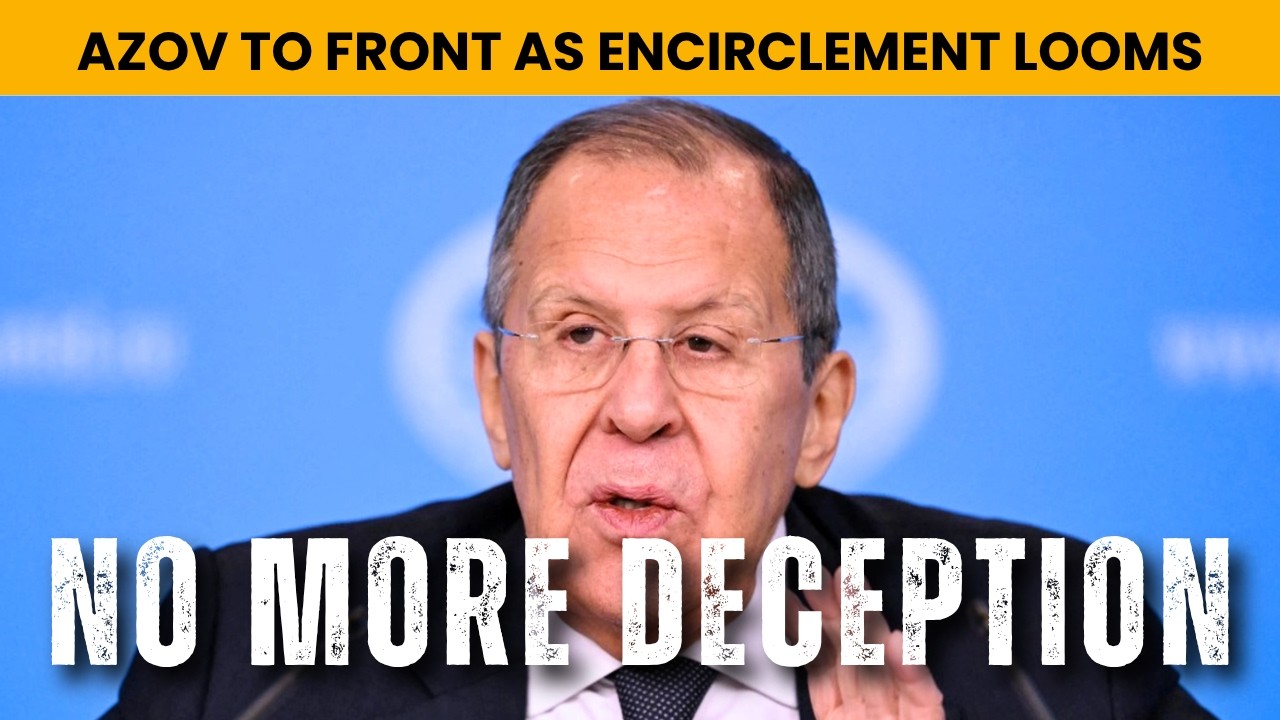
The military half turns on a Reuters relay: Ukraine is now actually having to send the Azov troops it long resisted deploying, to the Donbas lines near Kramatorsk and Slavyansk. (One detail in the episode does not match the report it cites: the host's aside names Zaluzhnyy as the new commander; Reuters names Drapatyi.) Mercouris's assessment is blunt: this cannot turn the Russian military back. The picture he paints, sourced to "the Russian military themselves" and to Ukrainian Telegram channels — sourcing from one side of the war, worth flagging: the Russians are close to capturing Orekhov in Zaporozhye, Ukraine is being pounded daily, and the US is out of air-defense missiles. The fortified towns are ringed from all four directions and very close now to being encircled — not next week, he hedges, but within weeks or months. By the Russian account he cites, they are halfway through Oleksiyivka, have entered Druzhkivka, and are closing on Dobropillya.
That leaves Ukraine the episode's central dilemma: hold and risk a cauldron — not of a few thousand men but tens of thousands, the better part of the Ukrainian army — or retreat and in effect give up eastern Ukraine, since beyond the Donbas sprawl the hosts see nothing stopping the Russians until the river. Zelensky has chosen to defend with his best troops, which Mercouris expects will set the scene for a massive encirclement battle: the decisive battle of the war. The closing warning is political. The Mariupol precedent — Zelensky did a deal with Erdogan, who broke promises to the Russians and let the encircled Azov leaders return to Ukraine — explains why Azov answers to itself. If encircled, they will likely pull back without orders, and a confrontation between Azov and Zelensky is one the hosts say Zelensky will not survive.
Interview Highlights
2 exchanges- Q
What did Lavrov tell the Vatican envoy and the CIA director in Moscow?
Alex Christoforou asked00:22AAlexander Mercouris answeredLavrov, in Mercouris's account, all but confirmed that Ratcliffe's Moscow visit was about Ukraine, and he discussed in some detail the exchange with Gallagher, the Vatican official sent to Moscow. The two visits at the same time were no coincidence: one was there to provide the ethical push, the other the hardline push to get the Russians to stop. Lavrov's message to both, as reconstructed from his statements: negotiations have been tried going back all the way to 2014, there has been no shortage of goodwill on the Russian side, and that goodwill has now gone, because Western policy and Western diplomacy are based on deception — the keyword. On the question of an ultimatum over US assistance in Ukrainian strikes against Russia, Lavrov said none was given, though it was discussed in every meeting. The consequence he draws: negotiations can only be based on trust, there is no trust, so the only outcome now is military, to be decided on the battlefields. In effect, both the Vatican official and the CIA director were given the brush-off.
- Q
Can the Azov deployment to the Donbas front lines stop the Russian advance?
Alex Christoforou asked15:53AAlexander Mercouris answeredCertainly not by turning the Russian military back. In Mercouris's account the Russians are tightening their ring around the fortified towns of the Donbas defense line — to the east, north, south, and west of them — and the encirclement is close now: not tomorrow or next week, but within the next few weeks or months. By the Russian military's own account they are halfway through capturing the southernmost of the towns, Oleksiyivka, have entered Druzhkivka, and are close to Dobropillya; if Dobropillya falls, the Russians can outflank the whole line. That leaves the Ukrainians a difficult decision: stay and risk a cauldron — not of a few thousand men but of tens of thousands, the better part of the Ukrainian army, since a whole string of towns is involved — or retreat and give up Donbas, in effect giving up eastern Ukraine, since beyond the Donbas urban sprawl and its difficult topography nothing stops the Russians until the river in its central sections, while they can also advance north towards Kharkiv or into the Chernihiv region with a large force concentrated. For now the decision is to defend, sending the best troops — consistent with the way Zelensky conducts the war — and that could set the scene for a massive encirclement battle, the decisive battle in the war.