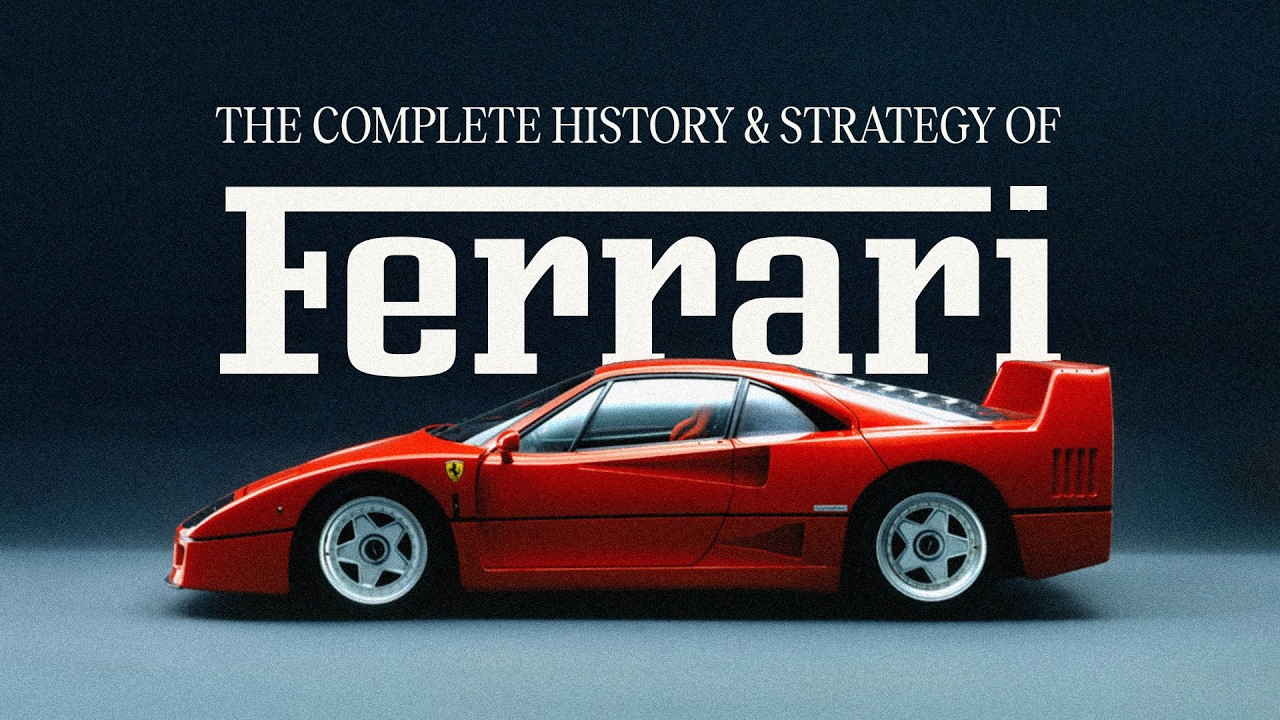
Ferrari: What happens when you staple a luxury brand to a sports team? (Audio)
Executive Summary
Ben Gilbert and David Rosenthal present Ferrari as a business built by joining three systems that ordinary automakers usually separate: a racing team, a low-volume road-car manufacturer, and a mythology strong enough to regulate who may buy the most desirable products. The historical account follows Enzo Ferrari from Alfa Romeo and Scuderia Ferrari through postwar road-car production, Luigi Chinetti's American distribution, Pininfarina design, the Ford rivalry, and Fiat's acquisition of control. Racing is treated not as a conventional marketing expense but as the continuous source of credibility that makes scarcity valuable. The episode's managerial center is Luca di Montezemolo. In the hosts' telling, Ferrari deteriorated after Enzo's death because Fiat-style volume growth weakened exclusivity while the products and Formula One team underperformed. Montezemolo's response combined lower production, better cars, an elite racing organization, and a customer progression system. The F355, Formula One dominance, waitlists, special series, and collector programs turned restricted supply into a repeat-purchase engine rather than a simple shortage. The final analysis asks whether modern Ferrari can preserve that system while expanding its model range, entering electric vehicles, and operating as a public company. The hosts see Purosangue, Ferrari Luce, high repeat-buyer rates, and margins far above mass-market automakers as evidence that the system remains intact. This conclusion remains interpretive: production figures, margins, ownership percentages, championship counts, and customer statistics are host-provided claims that require dated primary-source verification before publication as independent facts.
Chapters & Key Takeaways
Ferrari's Real Product Is a System of Desire
Introduction
Ferrari is often reduced to one famous rule: make one car fewer than the market wants. But low volume alone does not create a luxury company. It can just as easily create a small, fragile manufacturer. Ferrari's achievement is to make scarcity the visible result of a much larger system: racing produces credibility, road cars finance racing, controlled allocation turns buying into progression, and a global fan community keeps the myth alive far beyond the customer base.
Scarcity Is the Output, Not the Mechanism
When Luca di Montezemolo returned in 1991, the episode says Ferrari was producing too many weak cars, neglecting customers, and losing on the track. His first counterintuitive move was to reduce production from roughly 4,500 cars to 2,300 by 1993. The point was not simply to make Ferrari harder to buy. It was to restore the relationship between product quality, customer experience, and demand. Episode discussion 107:07 “By 1993, just 2 years later, Luca brought this down to 2,300” Direct Audio Anchor Listen from 107:07
Modern Ferrari manages that relationship centrally. The company controls its waitlist and allocations, limits how quickly models can be resold, and invites its best clients into increasingly rare categories. A buyer can move from a used Ferrari to a new range model, then to a special series, an Icona, a supercar, or even a one-off. The company is not merely withholding supply; it is designing a career for the customer. Episode discussion 151:19 “Ferrari decides centrally who gets the allocation” Direct Audio Anchor Listen from 151:19
Racing Makes the Myth Credible
This system began before Ferrari was a road-car manufacturer. Scuderia Ferrari combined a racing team, a constructor, and services for private clients. Racing victories demonstrated capability, generated public attention, and made customer cars desirable. The road-car business then funded the activity that created its own demand. Episode discussion 00:02 “the racing team, the constructor, and the services” Direct Audio Anchor Listen from 00:02
That relationship survives in Formula 1. Montezemolo's remark in the episode is precise: victories do not directly determine unit sales, but years of losing fail to “add wood to the fire of the myth.” Ferrari can lose; it cannot only lose. Formula 1 now contributes sponsorship and commercial revenue, but its deeper role is to keep every road car connected to a living competitive institution rather than to a finished history. Luca di Montezemolo, quoted in episode 95:58 “you do not add wood to the fire of the myth” Direct Audio Anchor Listen from 95:58
The Customer Climbs a Pyramid
Ferrari's ownership structure resembles a pyramid surrounded by a dense network of events, clubs, track programs, factory visits, service centers, and collectors. At the base are hundreds of millions of tifosi who may never buy a car. Higher levels contain used-car buyers, first-time new clients, repeat owners, collectors, and invitees to limited programs. At the extreme, a client can buy a former Formula 1 car while Ferrari stores it, maintains it, and provides the team required to operate it. Episode discussion 182:52 “Ferrari is both inclusive and exclusive” Direct Audio Anchor Listen from 182:52
The secondary market is not outside this system. Dealers retain strong incentives to trade used Ferraris, while Classiche certification can return an older car to official specifications and bind its maintenance history to Ferrari. The episode says more than 90% of all Ferraris ever produced remain on the road. That figure requires primary-source verification, but it captures the strategic point: a Ferrari does not leave the brand's economic and social universe when its first owner sells it. Episode discussion 172:30 “Over 90% of all Ferraris ever made ... are still on the road” Direct Audio Anchor Listen from 172:30
The Rarest Cars Carry the Economics
The product pyramid is also a profit pyramid. The hosts estimate that the F80 alone could contribute about 15% of annual revenue and roughly 30% of annual profit during its first delivery year. They also cite much higher margins for supercars and Icona models than for the regular range. These estimates need verification against Ferrari disclosures, but they explain why an occasional limited model matters far beyond its unit count.
The broader financial comparison points in the same direction. The episode reports a 50% gross margin, average profit above $170,000 per car, and a valuation multiple closer to leading luxury houses than to automakers. Ferrari still performs difficult engineering and manufacturing, so its economics do not reach those of a handbag company. But the market pays it for durable desire, not factory throughput. Episode discussion 192:55 “The profit per car average exceeded $170,000” Direct Audio Anchor Listen from 192:55
Continuity Is the Final Moat
Competitors can copy a limited production run, build a faster car, or create a customer club. What they cannot quickly reproduce is the continuity between Enzo's racing organization in 1947, the modern Formula 1 team, Pininfarina-era road cars, Montezemolo's turnaround, today's allocation system, and a community that welcomes fans while excluding almost everyone from the rarest products.
That is why the hosts' best formulation is also the simplest: Ferrari combines the exclusivity of a luxury brand with the inclusivity of a sports team. Ferrari Luce now tests whether this system can admit a new kind of engineering and a new customer group without breaking that continuity. The answer will not be determined by acceleration figures. It will depend on whether the car adds another credible form of desire to the same system. Episode discussion 213:34 “It has the exclusivity of a luxury brand but the inclusivity of a sports team” Direct Audio Anchor Listen from 213:34