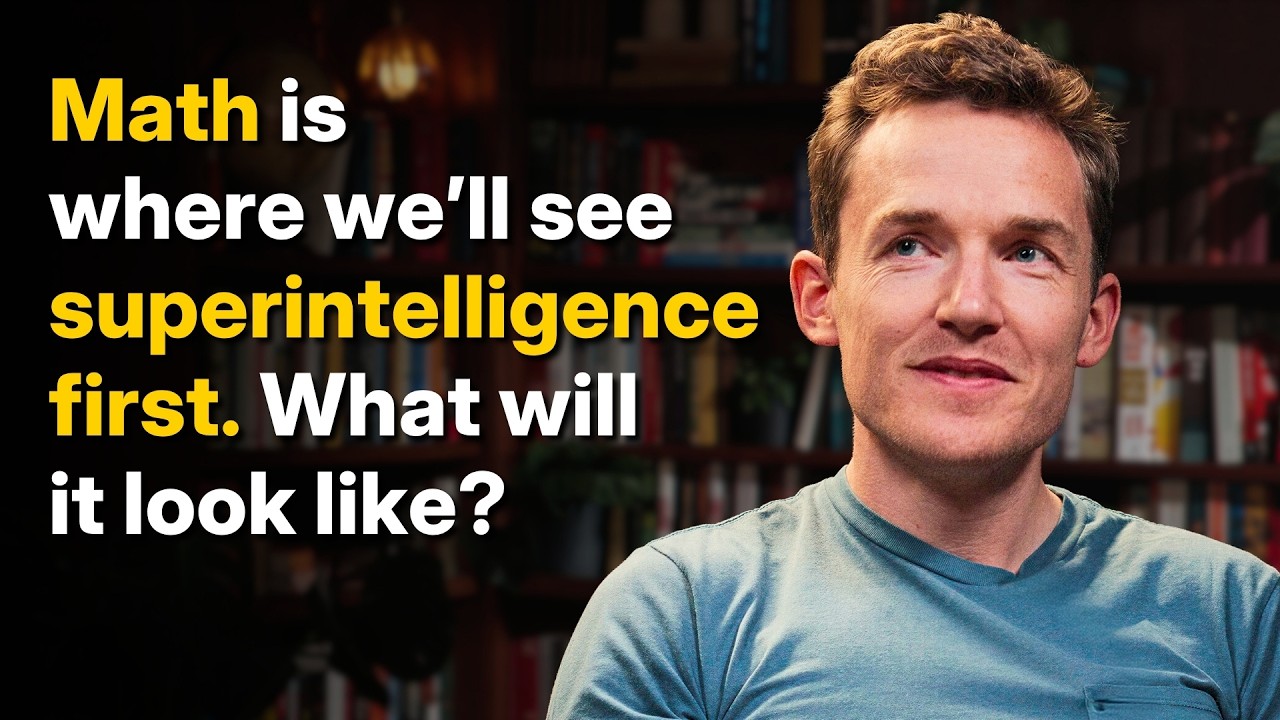
Grant Sanderson (@3blue1brown) – AI disproved a famous math conjecture. Now what?
Executive Summary
Grant Sanderson and Dwarkesh Patel examine AI progress in mathematics as an uneven frontier. They distinguish success on fixed benchmarks from creating conjectures, definitions, and explanations that people can understand. Future capabilities remain open questions.
Chapters & Key Takeaways
When a Correct Answer Is Not Yet Mathematical Understanding
A benchmark is not a final definition
Grant Sanderson argues that a high-profile result in mathematical problem solving would still be one benchmark among others, not a single moment at which general intelligence is settled. The discussion uses the International Math Olympiad and other fixed tasks to show how capability can be uneven across problem types. Grant Sanderson 00:01 “it'll be another benchmark like all these other benchmarks that are passing.” Direct Audio Anchor Listen from 00:01
The harder target is choosing what to think
The speakers move from solving a stated problem to generating conjectures, definitions, and conceptualizations that can unify fields. Those activities are difficult to turn into a clean score, precisely because their value is often recognized through later mathematical use and explanation. Grant Sanderson 08:04 “coming up with new kinds of objects or conceptualizations that create or unify fields.” Direct Audio Anchor Listen from 08:04
Explanation has a reader
The episode does not reduce mathematics to proof checking. It asks whether a system can help people understand a result, select useful questions, and communicate ideas. Sanderson connects that last task to theory of mind: writing must account for what another person can follow. Grant Sanderson 73:11 “models have bad theory of mind” Direct Audio Anchor Listen from 73:11
Keep the uncertainty
The conversation offers a way to inspect AI progress, not a prediction that models will soon originate whole fields of mathematics. The claims are attributed to the speakers, and the examples are used to clarify a distinction between verified outputs and understanding.