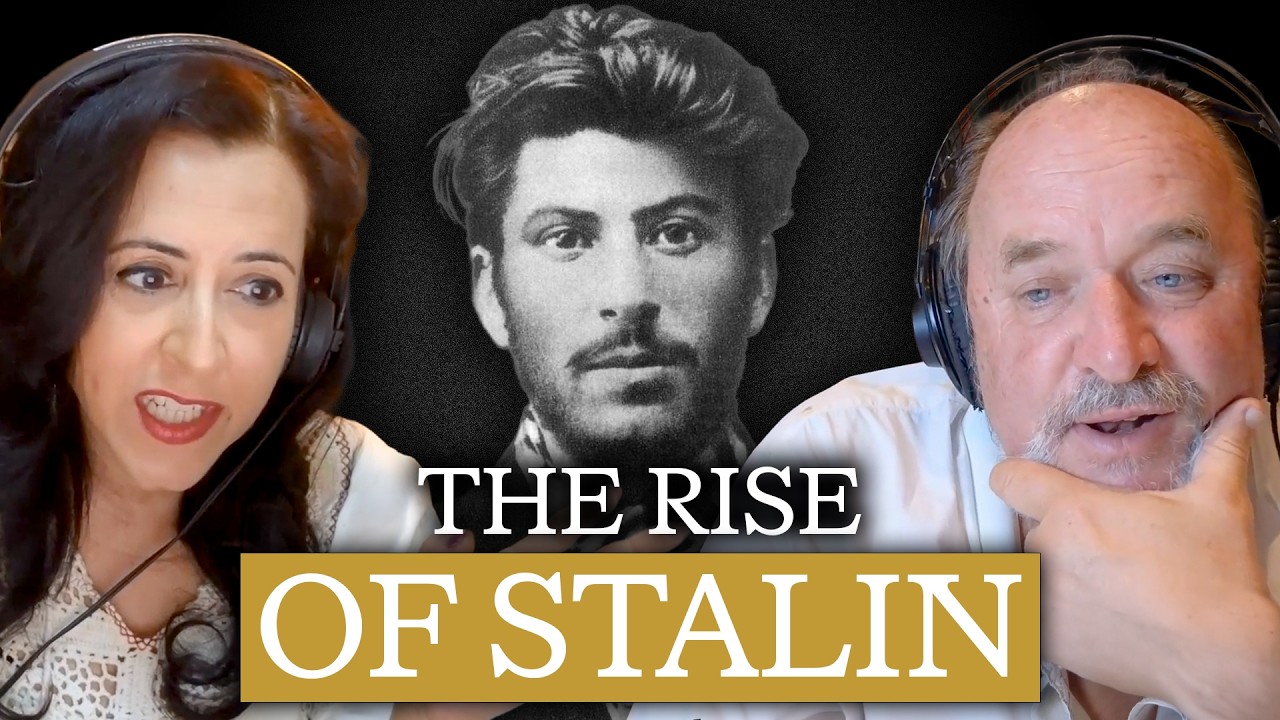
The Rise of Joseph Stalin, Explained
Executive Summary
In the first episode of a new series on Stalin, Anita Anand and William Dalrymple start from a May 2025 replica of a Stalin bas-relief in the Moscow metro and Putin's stated reasons for letting Stalin return: his 2017 complaint to Oliver Stone that 'excessive demonization' of Stalin attacks Russia, and his framing of Stalin as an effective manager. Against that revival they set the record of famine and terror estimated at 15 to 30 million lives. The body of the episode follows the Georgian childhood: the conflicting 1878 and 1879 birth records and Robert Service's draft-avoidance theory; the violent drunkard Beso and the devout, ambitious Keke; smallpox, a maimed left arm, and seminary-era poetry that proves a proud Georgian. The Tiflis Theological Seminary, a Russification instrument under Russian Orthodox control, pushes the surveiled student toward banned books, the bandit hero Koba who gives him his name, and, after public hangings in Gori, the 1907 Tiflis bank robbery whose quarter of a million rubles prove unspendable. The closing movement contrasts Stalin with Lenin, radicalized by his brother's 1887 hanging, and traces how Stalin's writing and organizing won him Lenin's patronage: the Central Committee in 1912 and unglamorous backstage work in 1917. The hosts close by rejecting Stalin's own hand-in-hand account of his path to Lenin and promising a next episode on how a boring theorist became general secretary.
Chapters & Key Takeaways
The Rise Of Joseph Stalin: The Early Years
Why is today's Russia bringing Stalin back, and who was the man before the power?
Introduction
In May 2025 a new bas-relief of Joseph Stalin appeared in a Moscow metro station, an exact replica of one torn down in the 1960s, and the question it raises is the question of this episode of Empire: why is today's Russia bringing Stalin back, and who exactly was the man before the power? William Dalrymple and Anita Anand trace the Georgian shoemaker's son who could have been a priest or a poet, and became first a bandit and then, quietly, one of the most feared dictators of the twentieth century. The installation was reported by The Moscow Times in May 2025 Radio Free Europe / Radio Liberty Corroborates 2017-06-16 Putin Accuses Russia's Foes Of 'Excessive Demonization' Of Stalin Verified Media Report Read Source Article ; Dalrymple described the relief itself as a new bas-relief of Joseph Stalin gone up William Dalrymple 01:44 “a new bas-relief of Joseph Stalin was installed” Direct Audio Anchor Listen from 01:44 in pure 1920s Soviet kitsch, Stalin three times life size, hand on chest, towering over children who look like Bolshoi dancers.
Why Putin Is Bringing Stalin Back
Asked directly by the director Oliver Stone in 2017 why Stalin was being brought back, Putin replied: "Excessive demonization of Stalin is one of the ways to attack the Soviet Union and Russia." William Dalrymple 03:20 “Excessive demonization of Stalin is one of the ways to attack the Soviet Union and Russia.” Direct Audio Anchor Listen from 03:20 The exchange was reported at the time by Radio Free Europe/Radio Liberty The Moscow Times Corroborates 2025-05-15 Moscow Metro Installs Replica of Stalin Monument Verified Media Report Read Source Article . In Dalrymple's account, Putin does not deny the deaths and the terror; he simply says Stalin was an effective manager William Dalrymple 04:09 “Stalin was an effective manager” Direct Audio Anchor Listen from 04:09 , a phrase the hosts note now appears in Russian history textbooks. For a record of famine and terror that took, by the most serious estimates, 15 to 30 million lives William Dalrymple 04:31 “from 15 to 30 million lives” Direct Audio Anchor Listen from 04:31 , Dalrymple called that the mildest possible description. Putin's accompanying argument, that Britain keeps its monuments to Oliver Cromwell despite his ambiguous role, struck Anand as a fair counterargument: from an Irish perspective, Cromwell is responsible for rivers of blood too.
Two Birth Dates For One Dictator
The episode opens on an odd fact: nobody knows for sure when Stalin was born. The parish register of the Church of the Assumption in Gori records December 18, 1878 William Dalrymple 05:47 “December 18, 1878” Direct Audio Anchor Listen from 05:47 , a date confirmed by his seminary certificate, the tsarist police file, and his own handwriting decades later. After coming to power, Stalin promoted a different birthday, December 21, 1879, celebrated with parades. The biographer Robert Service, Dalrymple noted, wrote that "Forgery came easily to him" William Dalrymple 06:22 “Forgery came easily to him” Direct Audio Anchor Listen from 06:22 , and argued, while admitting it cannot be proven, that the change helped the young Stalin avoid conscription.
A Georgian, Not A Russian
Stalin was not born Stalin. He was born Iosif Dzhugashvili in Georgia William Dalrymple 06:48 “He was born Iosif Dzhugashvili in Georgia” Direct Audio Anchor Listen from 06:48 , and being Georgian, Anand emphasized, was not a variation of being Russian: Georgia sits in the Caucasus beside Armenia, north of Iran and Turkey, with its own language, its own alphabet, and its own church, Georgian Orthodox, not Russian Orthodox Anita Anand 07:27 “Georgian Orthodox” Direct Audio Anchor Listen from 07:27 . Ruled from Moscow, Georgia felt colonized, and Georgians never reconciled themselves to it. A Georgian coming to power in Moscow, she said, is as unlikely as an Irish Catholic from Limerick taking power in London.
A Childhood Of Violence In Gori
The childhood landscape Anand described was brutal. Stalin's father, Besarion, was a Gori shoemaker, good at his craft but unwilling to move on from Cossack boots to European shoes; he grew bitter, drank, and the neighborhood called him crazy Beso Anita Anand 09:52 “crazy Beso” Direct Audio Anchor Listen from 09:52 . His violence fell mainly on his wife Keke and the boy Joseph. Stalin himself, Anand recounted, told his daughter Svetlana that when his drunken father was beating his mother, he threw a knife at his father Anita Anand 10:30 “He throws this knife at his father” Direct Audio Anchor Listen from 10:30 , missed, and hid with the neighbors for days. The father eventually left, which changed little for Keke but reduced the cruelty in the house.
Fragile Boy Or Little Thug?
Looking at a photograph of the six- or seven-year-old Stalin, the hosts split. Anand said, "I see someone very fragile" Anita Anand 11:41 “I see someone very fragile” Direct Audio Anchor Listen from 11:41 , a child with sad eyes who needed a hug. Dalrymple saw a little East End thug, ears sticking out, chin forward, hardened early. The boy survived smallpox Anita Anand 12:26 “smallpox” Direct Audio Anchor Listen from 12:26 at six, which left permanent scars; two older brothers had already died in childhood, and his mother was too poor for a doctor. A runaway horse-drawn carriage broke his nose and his left arm, which healed shorter. Smallpox, his father, and the carriage all failed to kill him; apart from his mother's love, all he knew was hardship.
The Poet In The Seminary
Towards the end of his adolescence two things happened: he starts writing pretty good poetry William Dalrymple 14:16 “he starts writing pretty good poetry” Direct Audio Anchor Listen from 14:16 , and he entered the Tiflis Theological Seminary in 1894. Anand read one of the poems, which closes, "Blossom, oh my Georgia, let peace reign in my native land" Anita Anand 14:48 “Blossom, oh my Georgia, let peace reign in my native land” Direct Audio Anchor Listen from 14:48 — the voice of a proud Georgian, not an amorphous tsarist subject. Behind the boy stood his mother Keke, devout and ambitious, wanting him to become a priest and rise. The seminary itself was, by all accounts, a harsh regime created for Russification Anita Anand 16:53 “created for Russification” Direct Audio Anchor Listen from 16:53 , with written reports on whether the students were good supporters of the tsar.
Banned Books And The Name Koba
Under that surveillance, young Joseph read what would have horrified the tsar: Marxism arrived, along with banned books such as Chernyshevsky's What Is to Be Done? and the Georgian novel The Patricide William Dalrymple 19:11 “The Patricide” Direct Audio Anchor Listen from 19:11 by Alexander Kazbegi, whose hero is a mountain bandit called Koba William Dalrymple 19:16 “a mountain bandit” Direct Audio Anchor Listen from 19:16 . Stalin took the name while still in seminary, Anand noted, citing Martin Amis's Koba the Dread: friends called him Koba. He then became, Dalrymple observed, what the name symbolized.
From Public Hangings To A Bank Robbery
What turned the seminarian into a bandit, Dalrymple argued, was the atmosphere in Georgia: two mountain bandits who shot a policeman over a stray cow were sentenced to death William Dalrymple 20:52 “hanged in the center of Gori” Direct Audio Anchor Listen from 20:52 and publicly hanged in the center of Gori, and Stalin, told not to go, watched anyway. He had left the seminary, married the devout Kato in 1906, and had a son, Yakov, in 1907. That same year his gang ambushed a bank carriage on Yerevan Square in Tiflis, almost within sight of the seminary: bombs from the rooftops, pistol fire, Stalin the organizer and leader. The take was a quarter of a million rubles William Dalrymple 23:10 “a quarter of a million rubles” Direct Audio Anchor Listen from 23:10 in canvas bags, yet not one ruble could be spent, because the bank had circulated the serial numbers of the large bills William Dalrymple 23:15 “the serial numbers of the large bills” Direct Audio Anchor Listen from 23:15 . Detained briefly for his first police photo, he came out, in Dalrymple's phrase, dry from the water.
Lenin's Man Behind The Scenes
How did the failed bank robber become essential to the Bolsheviks? Through Lenin, a completely different character, radicalized when his older brother was hanged in 1887 for trying to assassinate the tsar. The Bolsheviks, Dalrymple explained, were the wing of the party that was about power: do it quickly, whatever the cost, and it will cost rivers of blood William Dalrymple 27:36 “it will cost rivers of blood” Direct Audio Anchor Listen from 27:36 . Stalin's articles on the national question caught Lenin's attention, and in 1912 Lenin introduced him to the Bolshevik Central Committee William Dalrymple 28:05 “he introduces him to the Central Committee of the Bolsheviks in 1912” Direct Audio Anchor Listen from 28:05 as organized and systematic, able to do tedious work and secure funding. Yet in 1917 Stalin was not the man on the barricades: he was doing the behind-the-scenes work William Dalrymple 28:22 “behind-the-scenes work” Direct Audio Anchor Listen from 28:22 . Trotsky, Anand noted, dismissed him as an ordinary accountant Anita Anand 28:53 “an ordinary accountant” Direct Audio Anchor Listen from 28:53 while everyone else gave their lives — which, the hosts suggested, probably hurt him deeply. The next episode covers how the boring theorist became general secretary.
Interview Highlights7 exchanges
Direct dialogue & timestamps from the recording
What on earth is going on with this new Stalin bas-relief, and why is Putin so condescending to Stalin?
Putin answered this directly in a 2017 conversation with the director Oliver Stone. Asked why he was bringing Stalin back and turning him into 'Grandpa Joe,' the grandfather of the nation, he replied: 'Excessive demonization of Stalin is one of the ways to attack the Soviet Union and Russia,' adding that 'we apologized too much for the past' and 'for dictators.' Putin has named the men he looks up to as Peter I, Catherine the Great, and Stalin — examples of a strong hand. He does not deny the deaths and horrors; he simply says Stalin was an effective manager, an expression that itself appears in Russian history textbooks, a mild description for a man whose famine and terror took, by the most serious estimates, 15 to 30 million lives. Putin also argues that Britain keeps monuments to Oliver Cromwell despite calling his role very ambiguous, so Russia can live with Stalin on a pedestal — though from an Irish perspective, Cromwell is responsible for the rivers of blood shed in Ireland.
Why did Stalin change his own birth date?
In his biography, Service aptly notes: 'Forgery came easily to him' — a theme running through the entire cycle. He has another theory, which cannot be proven but is convincingly argued: changing the date helped Stalin avoid being drafted into the army in his youth. So we don't know for sure.
Was the Georgian Orthodox Church really the center of resistance to Russification, or the other way around?
By name it is the Georgian Orthodox Church, but the church itself and the seminary at that time were under the control of the Russian Orthodox Church — an important distinction.