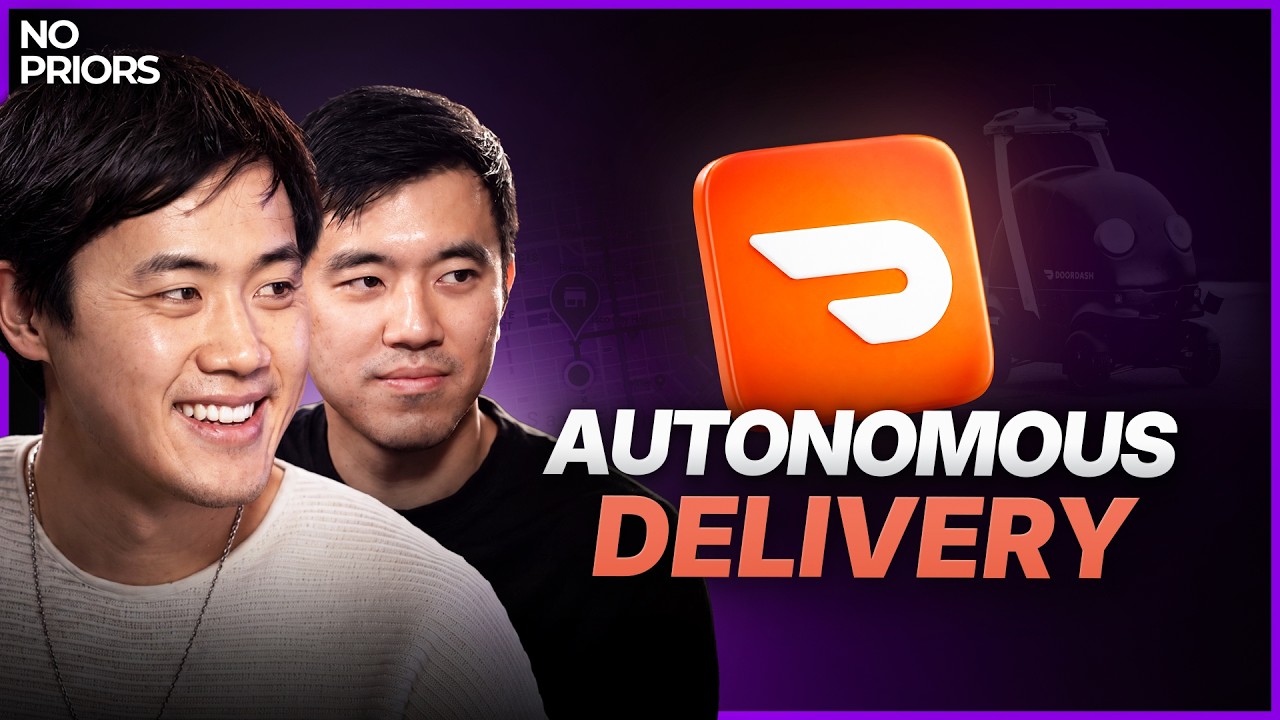
Building an Autonomous Delivery Experience with DoorDash Co-Founders Andy Fang and Stanley Tang
Executive Summary
DoorDash co-founders Andy Fang and Stanley Tang describe a single strategy connecting conversational commerce, physical delivery automation, and company-wide AI adoption: begin with a concrete customer workflow, deploy into the real operating environment, and let observed constraints determine the product. Ask DoorDash is presented as an early agentic interface that changes discovery and basket construction, while DoorDash Dot is presented as a purpose-built response to the mismatch between sidewalk robots and passenger robotaxis. The episode's deeper argument is that physical-world autonomy is not primarily a model demonstration. It requires dispatch, merchant integration, first-and-last-100-foot knowledge, fleet maintenance, manufacturing, and the ability to route each delivery to an appropriate human or machine modality. The final section applies the same realism to enterprise AI: benchmarks and sanitized tasks are insufficient unless model costs and performance are measured against actual work.
Chapters & Key Takeaways
DoorDash's Next Competition Will Not Happen Inside the Model Alone
Introduction
Ask DoorDash and the delivery robot Dot look like separate product lines: one lets a customer describe what they want to buy, while the other moves an order through the physical world. DoorDash co-founders Andy Fang and Stanley Tang describe them as products of the same method. Start with the job a customer needs done, then make the model, hardware, and operating system serve that job.
Natural language changes how demand is expressed
Traditional search asks customers to compress intent into keywords. A conversational interface can accept a fuller situation: what is missing from a refrigerator, which family members have dietary restrictions, what someone wants to cook, or when an office pantry needs restocking. Fang says that about half of Ask DoorDash restaurant journeys lead to a restaurant the customer has not ordered from before, while grocery baskets are larger. These are company claims rather than independently verified measurements, but they show that the team evaluates conversation through changed purchasing behavior, not novelty alone. Andy Fang 02:00 “50% of those trajectories are people ordering from places they've never ordered from before” Direct Audio Anchor Listen from 02:00
That shift moves DoorDash from an ordering surface toward a coordinator of demand. A family dinner requires attendance, allergies, preferences, timing, and delivery to be reconciled. An office replenishment workflow can begin when a camera observes an empty shelf. Agentic commerce matters when context that previously required repeated human coordination becomes executable.
Work backward from the delivery problem
DoorDash began autonomy experiments in 2018 with a very small team and external partnerships. The partnerships showed that autonomy needs dispatch, APIs, merchant integration, customer experience, and field operations around it. More importantly, Tang argues that the machine must be designed backward from a delivery use case rather than built first and assigned a problem later. Stanley Tang 12:00 “this idea of building towards a use case” Direct Audio Anchor Listen from 12:00
Sidewalk robots were too slow for the three-to-five-mile average delivery Tang describes. Robotaxis were designed to carry people, adding weight and equipment unnecessary for a few meals. A passenger can walk half a block to a car; a package cannot solve the final hundred feet itself. DoorDash therefore pursued a middle form factor. Tang describes Dot as a roughly 300-pound, 20-mile-per-hour in-house vehicle able to move among sidewalks, bike lanes, and roads. Stanley Tang 20:00 “weighs 300 lb, travels up to 20 mph” Direct Audio Anchor Listen from 20:00
The real world creates problems the lab does not contain
A robotics demonstration can choose its route. A delivery network cannot. Camera lenses collect dirt. One side of a vehicle may run over leaves while the other remains on asphalt. Regenerative braking can stress a battery. A temporary startup script that is acceptable for a prototype can become an operating failure when hundreds of vehicles boot every morning. Tang's central point is that a system must make contact with the real world early because many important failures cannot be enumerated in advance. Stanley Tang 26:52 “You have to put something out in the real world make contact with the real world” Direct Audio Anchor Listen from 26:52
Addresses expose the same gap. A map pin is not an apartment entrance, a storefront, or a porch. Human Dashers correct imperfect maps through judgment. DoorDash hopes to learn from where deliveries were actually completed. Its proposed data advantage is therefore specific: not data volume in the abstract, but records tied to pickup, routing, exceptions, and the first and last hundred feet.
This also explains a multimodal fleet. Dot may handle suburban orders; drones may fit light orders in remote areas; a complex grocery order that requires picking, packing, and stairs may still require a Dasher. The platform does not need one machine to solve every environment. It needs to select a workable modality for each delivery.
Once autonomy works, scaling has only begun
As the autonomy stack becomes viable, constraints move toward manufacturing, component life, fleet maintenance, city-specific operations, and merchant workflows. Tang says autonomy itself is becoming less of the primary blocker while hardware and operations grow more important. Stanley Tang 36:40 “autonomy is probably increasingly becoming less and less of a constraint” Direct Audio Anchor Listen from 36:40
The same realism governs internal AI adoption. DoorDash released DashBench to evaluate models and harnesses on coding work and is exploring cheaper open-weight models for suitable tasks. Fang says June spending was roughly twenty times January spending before beginning to flatten, another company figure not independently checked here. Andy Fang 41:40 “our spend in June went up like 20x versus what the spend was in January” Direct Audio Anchor Listen from 41:40 A model that excels on sanitized evaluation data may still fail on accounting, analytics, or operations with full enterprise context.
Automation expands a network rather than making one substitution
When Sarah Guo asks whether robots eventually eliminate all Dashers, Tang predicts the opposite: DoorDash may have more human Dashers in ten years because demand and network scale may grow as well. Stanley Tang 45:00 “in 10 years time, we're actually going to have more Dashers doing doing deliveries, not less” Direct Audio Anchor Listen from 45:00 This is a company forecast contingent on growth, cost, and technical progress, not a verified labor outcome.
The more durable idea is the system behind the forecast. A delivery network can include people, Dot, drones, and autonomous cars at the same time, while agentic interfaces generate richer and more persistent demand. Fang expects natural interaction to reduce ordering friction and make workflows such as automatic pantry replenishment practical. Andy Fang 47:00 “it's going to reduce the friction in terms of their compelling them to place an order” Direct Audio Anchor Listen from 47:00
The competitive proposition in this conversation is not simply who owns the strongest model. It is who can connect models to real demand, real streets, and a real organization, then absorb every detail that appears. Models determine what may be possible. Operations determine whether it happens.