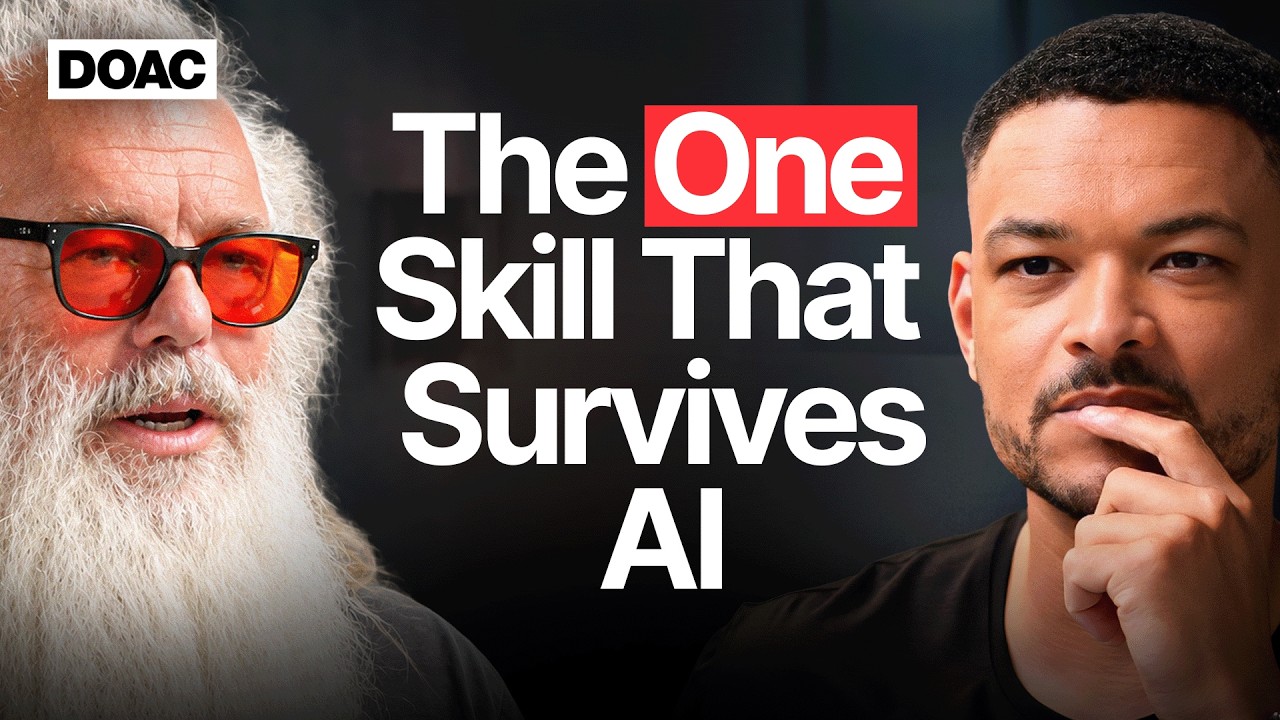
Rick Rubin: The Only Skill That Matters Now Is The One Thing AI Can Never Steal!
Executive Summary
Legendary producer Rick Rubin joins Steven Bartlett for a conversation about creativity, taste, and the one skill AI cannot steal. The episode's origin story is its own thesis: a vibe-coding meme attached to Rubin's image became a joke tweet that reached a million and a half views, and answering that energy with a book on vibe coding was, by his own description, an indefensible act with no reason behind it. Across the conversation he returns to the rule he has followed since the Def Jam days: make what you love and never ask what the audience or the market will think. Rubin locates the artist's irreplaceable core in point of view rather than execution. Jay-Z recorded 99 Problems from memory because the song happened in his mind; Kanye is fearless in art and life; Eminem fills notebooks as practice, 99% of which no one will ever see. AI, in Rubin's telling, is the collected ideas that already exist — a tool that may let more people be creative, but not a being that sees the world from its own angle. The host's counterpoint is personal: he liked an AI-made song less once he learned its origin. The conversation also turns inward: the professional rejection that became a depression Rubin describes as being shot with a poison arrow — no sleep, constant nausea, therapy five days a week — an experience he nonetheless would not erase. His prescription is museums, great literature, and ancient wisdom: the Dao that reads as a different book at every point in life and became the model for The Way of Code, and Jung's synchronicity, invoked when the book's 83 sections became 78 overnight, rhyming with the tarot deck's 78 cards.
Chapters & Key Takeaways
Rick Rubin: Tools Come And Go, Taste Remains
What does Rick Rubin identify as the irreplaceable human element of creativity in an age when AI can generate endless material, and how does he say it is cultivated?
Introduction
When Steven Bartlett put the question of the moment to the producer Rick Rubin on this September 2026 episode of The Diary Of A CEO — what is left for human creators when AI can generate music, images, and text at scale — Rubin offered no technology forecast. He fell back instead on a principle from decades of record production: "tools will come, tools will go, only the vibe coder remains." Rick Rubin 07:18 “tools will come, tools will go, only the vibe coder remains” Direct Audio Anchor Listen from 07:18 The conversation that follows reads as a creative philosophy built on taste, point of view, and hand labor.
How A Meme Became A Book
The episode is itself a case study. An image of Rubin attached to a vibe-coding joke circulated online; his offhand reply drew roughly a million and a half views, and he then decided to make a book about vibe coding — a project he calls indefensible by his own standard. In his telling, this mirrors a lifelong observation: revolutionary work arrives without context, and even its maker cannot fully defend it at first.
Never Consider Near-Term Incentives
From the Def Jam years onward, Rubin's rule has been to ignore the market. Encyclopaedia Britannica Corroborates 2009-02-13 Rick Rubin Verified Media Report Read Source Article "We never consider near-term incentive ever at any point in time," Rick Rubin 11:59 “We never consider near-term incentive ever at any point in time.” Direct Audio Anchor Listen from 11:59 he said. He does not use data in creative decisions; choosing projects depends on whether he can hear a path in the material. He has practiced Transcendental Meditation since fourteen and meditates with artists before sessions — described, in his account, as a way of keeping the antenna tuned so inner feeling can do its work.
Rationality Overrated: Feeling Before Measurement
Asked about the Bezos-style bet on what will not change, Rubin goes further: "I would say rationality is overrated." Rick Rubin 86:41 “I would say rationality is overrated.” Direct Audio Anchor Listen from 86:41 He grants that the Moneyball approach is one way of seeing the world, but argues some judgments — meeting the person you want to spend your life with, for instance — no metric can compute. His prescription is to hand the decision to an internal compass fed by large amounts of conflicting information, with as much inward checking time as it takes.
AI Can Make Ten Thousand Songs, But It Has No Point Of View
On artificial intelligence, Rubin's emphasis is not generation but point of view. In his account, AI is a collection of existing ideas that does not see the world from any particular angle; he cannot imagine it replacing artists end to end, though it may give more people access to making things. The art lives in ideation, not execution — "The art's always in the ideation. That's where the art is. It's not who put the paint on the canvas." Rick Rubin 97:56 “The art's always in the ideation. That's where the art is. It's not who put the paint on the canvas.” Direct Audio Anchor Listen from 97:56 He cites Hitchcock's and Wes Anderson's shot-by-shot storyboards and Warhol's silk screens, which the artist never touched, as evidence.
Bartlett offers a controlled experiment of his own: he liked a song on Spotify, then discovered about two months later that it was made by AI. "I didn't like it as much anymore." Steven Bartlett 96:29 “I didn't like it as much anymore.” Direct Audio Anchor Listen from 96:29 What was lost, for him, was resonance and provenance; Rubin's rejoinder — you did like it before you knew — leaves the question less settled than it first appears.
Fearlessness, Risk, And The Man Who Writes From Memory
Rubin says the great artists he has worked with were ordinary people who made a decision. Jay-Z's distinction was a songwriting process no one else had: for "99 Problems," he sat silent through twenty or thirty minutes of the looping beat, then performed complete verses from memory — "No, nothing was written. Just he just remembered it." Rick Rubin 127:57 “No, nothing was written. Just he just remembered it.” Direct Audio Anchor Listen from 127:57 Same words on every take, different cadence, like a saxophonist's solo.
Kanye West's trait, in Rubin's summary, is total fearlessness. Rubin says he is fearless only in art; Kanye is fearless in life as well. Rick Rubin 137:48 “I'm totally fearless when it comes to art.” Direct Audio Anchor Listen from 137:48 For risk and reward he reaches for the Cristal-to-Ace-of-Spades story: after the champagne's executive disparaged hip-hop drinkers, Jay-Z pulled it from his clubs with no plan to start a brand, and the opportunity arrived almost immediately — "Jay did the right thing and in response for doing the right thing, he ended up owning a champagne brand." Rick Rubin 117:05 “Jay did the right thing and in response for doing the right thing, he ended up owning a champagne brand.” Direct Audio Anchor Listen from 117:05 Rubin allows it could be called karma; Bartlett adds that Jay-Z's stake was reported at 630 million dollars when sold.
The Ninety-Nine Percent Notebook
Asked about Eminem, Rubin names a plainer form of irreplaceability: always writing. In Eminem's notebooks, "99% of this stuff no one will ever see" Rick Rubin 142:22 “99% of this stuff no one will ever see.” Direct Audio Anchor Listen from 142:22 — he only wants to get better, like an athlete who trains in the offseason. Rubin extends the same logic to everyone: each person has the potential to be the greatest version of themselves, shining brighter at their own thing than anyone else.
A Poison Arrow And A Past He Would Not Erase
The most personal stretch of the conversation is the unconscious-level depression that followed Rubin's first major professional rejection at thirty-three: sleeplessness, constant nausea, therapy five days a week, an anti-depressant as a last resort. "I was shot with a poison arrow." Rick Rubin 01:53 “I was shot with a poison arrow.” Direct Audio Anchor Listen from 01:53 He says he would not press a button to erase the experience — the collapse is what let him understand the artists he works with. In the hospital room after a friend's survived suicide attempt, the first thing he said was: you are in the sweet spot; the reset button has been pressed.
Seventy-Eight Sections And A Thank-You Call
Two closing details gather the theme. The first concerns his book: finished with eighty-three or eighty-four areas of thought, he wanted seventy-eight — and the next day, after his assistant ordered the sections, there were seventy-eight. "I wanted it to be 78 and the next day there were 78 and nobody did anything." Rick Rubin 161:58 “I wanted it to be 78 and the next day there were 78 and nobody did anything” Direct Audio Anchor Listen from 161:58 He attributes it to synchronicity. The second is the closing phone-call question, which he answers with gratitude rather than apology — "I would probably call Mourielle, my wife, and just thank her for being in my life." Rick Rubin 163:06 “I would probably call Mourielle, my wife, and just thank her for being in my life.” Direct Audio Anchor Listen from 163:06 In fifteen years of marriage, they have spent perhaps three nights apart.
The episode's answer, in the end, is not a list of skills but a position: generation keeps getting cheaper, while taste, point of view, and the person willing to bear risk for them remain scarce.
Interview Highlights7 exchanges
Direct dialogue & timestamps from the recording
What art that you've been involved in creating would you define in the moment as being indefensible?
A little over a year ago there was a meme about vibe coding — Andrej Karpathy had just coined the term and someone attached a picture of me wearing headphones with my eyes closed, hand on a mouse. It had nothing to do with me, but over the next few days friends sent me hundreds of versions of that image. The old me would have laughed and moved on, but I read the energy coming at me as an invitation, and answered it with a joke tweet — "tools will come, tools will go, only the vibe coder remains" — which got a million and a half views against the ten or twenty thousand my tweets usually get. Something was going on. It was an indefensible act: there was no reason for me to do it. Taking that as a call, I put aside all of my professional work to write a book about vibe coding. I couldn't explain it, couldn't tell you why, couldn't say it was a good idea — I was following a calling, feeling invited to participate, and writing the book was the way I could answer the call. So I did.
What was going on under the surface of that depressive episode?
It was all happening on the unconscious level. I couldn't sleep, was nauseous constantly, didn't want to get out of bed. I felt it physically and didn't want to do anything. I've heard it described as being shot with a poison arrow, in a philosophical or psychological sense — I was shot with a poison arrow.
Do great artists work hard?
Very hard. From the outside it looks like you check into the studio, make something, put it out, and everybody screams on tour — but it's a grueling job, everything about it is hard. It's wildly competitive, not because you're competing with other people, but because a lot of people are trying to do it. You can be tremendously talented, but without the work ethic to go with it, it's unlikely anyone will ever hear what you do. It's a combination of a diligent work ethic — doing whatever it takes — and an interesting view of the world that makes someone think, hm, I never saw it that way before.