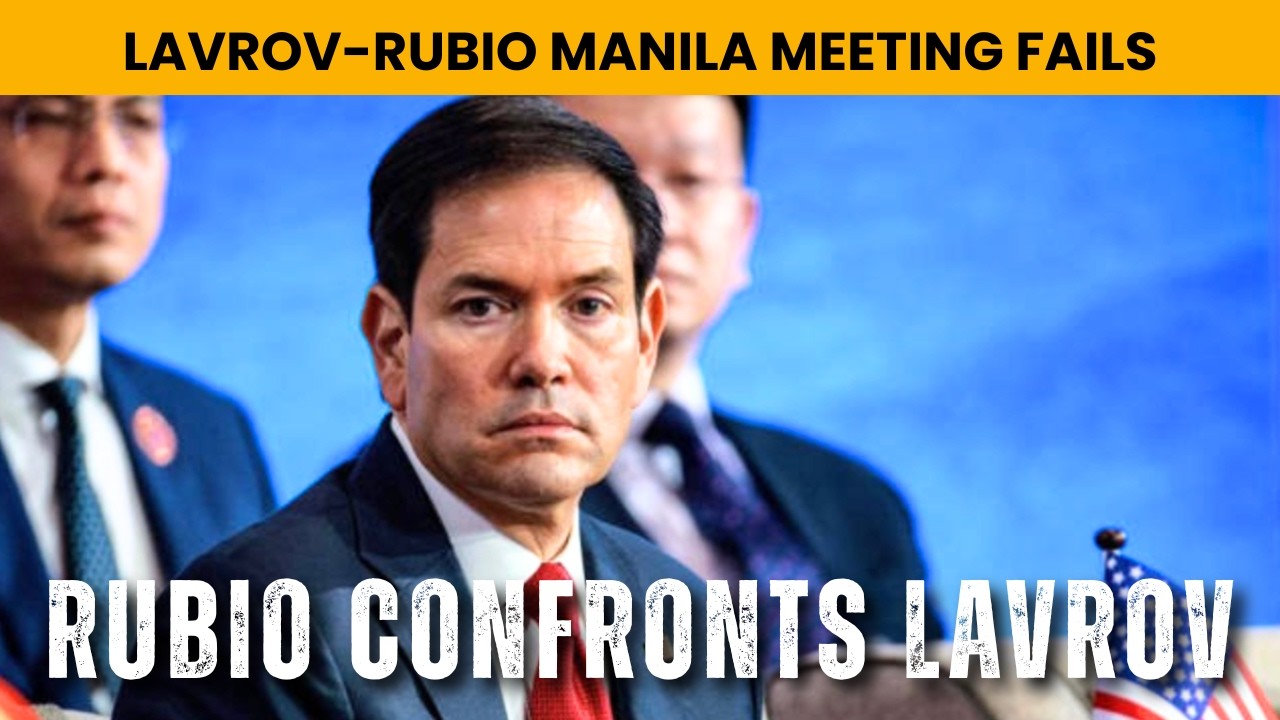
Manila Meeting: Lavrov, Rubio And Iran Strikes CIA Facilities
Executive Summary
Alex Christoforou and Alexander Mercouris discuss Sergey Lavrov's meeting with Marco Rubio in Manila, interpreting its short duration and limited public outcome as evidence that it failed to resolve the underlying dispute. They connect the meeting to allegations that Russia supplied intelligence or drone technology used by Iran against CIA-related facilities, and argue that Washington is increasingly concerned about Russian assistance to Iran. These allegations are not independently verified in the episode. The discussion then moves between Iran and Ukraine. The hosts describe alleged decision-making involving Trump, Netanyahu, and Mossad chief David Barnea; a reported warning from Putin after an attack associated with Valdai; Peskov's denial of a Bloomberg report; and possible changes to Russian negotiating demands concerning Kharkiv and Sumy. They consider sanctions, satellite intelligence, and covert action as possible US responses, and close by predicting an intensified shadow war and Russian retaliation.
Chapters & Key Takeaways
Thirty-Five Minutes in Manila Expose the Boundaries of Open Diplomacy
Introduction
Lavrov and Rubio met in Manila for about thirty-five minutes, with no joint statement and no public results. Alexander Merkouris concluded from this that the talks did not resolve the issues the United States had hoped to address. RFE/RL Corroborates 2026-07-23 No Breakthroughs, Little Optimism As Rubio, Lavrov Meet On Ukraine War Verified Media Report Read Source Article Listen · 00:55
A short meeting does not automatically equal failure. But since the Russian side said the meeting was requested by the United States, the host speculated that Washington came with specific demands, and Russia did not give the answers it wanted. The entire episode kept asking: was that demand related to Ukraine, or to Iran?
CIA Facilities Connect Two Battlefields
The program discussed a question raised by media reports: whether Russia provided Iran with intelligence or drone technology to help Iran attack facilities linked to the CIA Al Jazeera Corroborates 2026-07-23 Has Russia helped Iran target CIA sites in the Gulf? Verified Media Report Read Source Article . Merkouris believes Russia is helping Iran, but the program provided no intelligence documents, technical evidence, or official confirmation.
The host's reasoning was that the United States has long provided intelligence and targeting support to Ukraine, and Russia may provide similar support to Iran. When Iran becomes able to attack U.S. facilities more effectively, Washington begins to feel the pressure it once applied to Russia. This is an explanation based on symmetrical retaliation, not a factual determination of Russian-Iranian cooperation.
The program cited Rubio's dual role in diplomacy and national security as a reason the talks might have touched on CIA facilities. Alex Christoforou 04:27 “Is Rubio still the NSA head?” Direct Audio Anchor Listen from 04:27 This role connection can explain why the topic might have come up, but it cannot prove that it actually did in the closed-door talks.
Negotiations Continue, But Conditions May Have Changed
Discussion then turned to Ukraine. Merkouris said Putin may have warned Trump after the Valdai-related attack that Russia would reconsider concessions made earlier. Alexander Mercouris 15:07 “The Russians would rethink their concessions, the previous concessions they had made.” Direct Audio Anchor Listen from 15:07 This claim relies on the host's interpretation of reports, phone calls, and Russian statements; the program provided no directly verifiable record of the talks.
The host also distinguished two channels: Lavrov and Rubio represent formal diplomacy, while other envoys are closer to informal messaging between presidents. Russia's agreement to meet shows communication has not been interrupted; the lack of results shows that communication itself does not equal policy concessions.
This also explains the significance of the thirty-five minutes. It does not necessarily prove diplomatic failure, but it shows that open channels can convey positions, yet may not have the authority to change conditions already set at the highest level.
When Conventional Tools Are Constrained, Competition May Move into the Shadows
The program closed by assessing possible U.S. responses. The host believes that a large-scale increase in weapons for Ukraine is constrained by inventories and Middle East demands; further sanctions remain possible, but their effectiveness and blowback are both in question. Alexander Mercouris 23:04 “I think there will be more sanctions.” Direct Audio Anchor Listen from 23:04
Merkouris predicted from this that the United States and Ukraine may step up a "shadow war," including covert operations, assassination attempts, and drone strikes. Alexander Mercouris 23:54 “Ramp up the shadow war, the dirty war.” Direct Audio Anchor Listen from 23:54 Christoforou described it as a possible CIA response, and Merkouris immediately added the other half: Russia would retaliate. Alexander Mercouris 24:29 “Russia would then retaliate.” Direct Audio Anchor Listen from 24:29
These are future scenarios, not confirmed actions. Yet they point to the program's core concern: when formal diplomacy cannot produce exchanges, and weapons and sanctions are constrained by cost, competition may not stop—it may instead move into areas where responsibility is harder to establish and miscalculation is easier.
So the Manila talks leave no clear answer. Thirty-five minutes can only prove that both sides remain willing to sit down, not that either side is willing to change course. What really needs continued observation is whether open negotiations are still shrinking, and whether conflicts that cannot be resolved at the table are increasingly moving beyond it.