Trump Goes to Beijing. Neocon Push for Iran Ground Invasion
Executive Summary
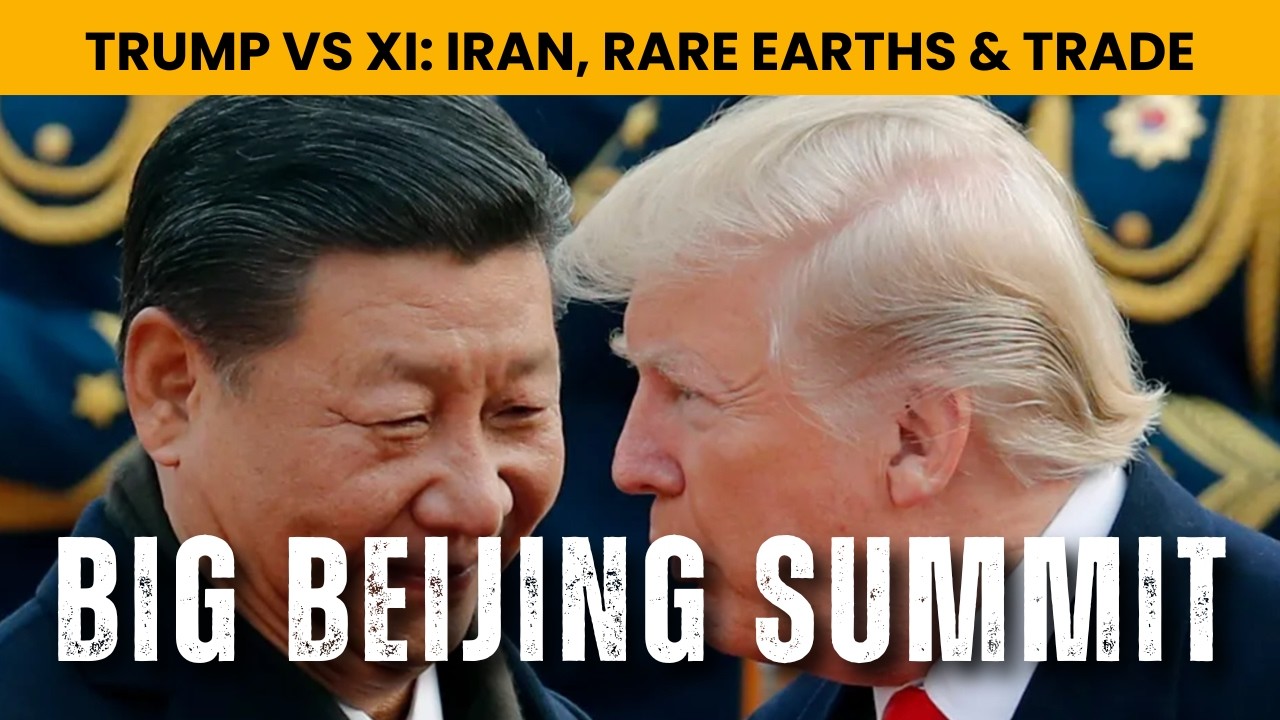
Alex Christoforou and Alexander Mercouris discuss Donald Trump's planned meeting with Xi Jinping in Beijing. Mercouris argues that Trump originally expected trade pressure, pressure on Russia, and a rapid collapse of Iran's government to give him a strong negotiating hand. In Mercouris's account, China instead withstood the trade confrontation, retained leverage through rare earths and alternative energy supplies, and may now be necessary to any exit from the Iran conflict. The discussion then turns to a Robert Kagan article in The Atlantic. Mercouris rejects the view that the article signals acceptance of defeat; he reads its discussion of a politically difficult ground operation as an indirect case for further escalation. The episode's claims about leaders' motives, national leverage, energy resilience, and private neoconservative advocacy are the speakers' interpretations and have not been independently verified.
Chapters & Key Takeaways
The Beijing Summit's Reversed Leverage
Why does Mercouris believe Trump's pressure on Iran weakens his position with China while increasing the risk of a wider war?
From a Strong-Hand Plan to a Weak-Hand Meeting
The episode treats Donald Trump's Beijing visit as a negotiation whose balance changed before it began. Alexander Mercouris says Trump expected to approach Xi Jinping after trade pressure had weakened China and military pressure had rapidly changed Iran. Neither condition, in his telling, was achieved.
Mercouris argues that China demonstrated strong leverage through rare-earth supplies during the previous year's trade disputes. Alexander Mercouris 02:56 “They showed that they have a very strong cards to play with rare earths.” Direct Audio Anchor Listen from 02:56 He also points to court setbacks for Trump's tariff policy. On Iran, he notes that the government remained in place and that China continued to support it. Alexander Mercouris 04:18 “Iran is still there. China continues to back it.” Direct Audio Anchor Listen from 04:18 These developments underpin his conclusion that the bargaining position has reversed. Rather than dictating terms in Beijing, Mercouris says Trump now arrives while China holds leverage over him. Alexander Mercouris 04:54 “he's going to China and it's the Chinese who have leverage over him.” Direct Audio Anchor Listen from 04:54
This is the episode's political assessment, not an independently verified measure of national power. Its importance lies in the connection the hosts draw between trade policy, the Iran war, and the need for the summit: Trump may need an agreement while having less ability to determine its terms.
Why the Blockade May Increase China's Leverage
Christoforou asks whether Trump is seeking an exit from the Iran conflict or trying to use it against China. Mercouris's answer is that Trump is attempting to recover leverage through harsher pressure. He points to an intensifying blockade after Trump rejected what Mercouris considered an Iranian opening bid. Alexander Mercouris 06:33 “He's still got this blockade in place, and the blockade has been intensifying” Direct Audio Anchor Listen from 06:33
Mercouris argues that the strategy misreads China's energy position. He says China can draw on reserves and supplies from Brazil, Russia, and, to some extent, Iran. He also emphasizes China's large tanker fleet as a means of moving Russian oil without depending only on pipelines. Alexander Mercouris 09:05 “of ships and China has an enormous tanker fleet” Direct Audio Anchor Listen from 09:05 The episode does not independently verify those supply claims, but they are central to Mercouris's forecast.
Mercouris predicts that further escalation would “play straight into” China's hands and give Beijing more leverage. Alexander Mercouris 08:01 “going to play straight into their hands. They're going to get even more leverage” Direct Audio Anchor Listen from 08:01 His reasoning is diplomatic as well as economic: if China becomes important to negotiations among Iran, Saudi Arabia, and other regional actors, Washington may need Beijing's help to end the crisis. Pressure intended to isolate China could therefore make China more consequential.
The Grand Bargain Trump Expected
Mercouris says Trump's original strategy depended on arriving with several geopolitical successes already secured. He describes an expected position in which Venezuela and Iran were controlled, while Russia had either reached an accommodation with Washington or entered political disorder. Those assertions are Mercouris's account of Trump's strategy, not evidence of a confirmed plan.
From that imagined position of strength, Trump would seek a sweeping agreement. Mercouris summarizes its central demands as Chinese restraint over Taiwan and greater openness to American finance and industry. Alexander Mercouris 13:08 “massive deal with China. You leave Taiwan alone. You open up China to American finance and industry” Direct Audio Anchor Listen from 13:08 Trump could then present the result at home as a grand deal.
The episode's argument is that the prerequisite victories never occurred. Trump is still going to Beijing, but Mercouris says he is doing so after losing the leverage on which the envisioned bargain depended. That leaves the summit less like the culmination of a successful pressure campaign and more like an effort to manage the consequences of one.
The Ground-War Risk Behind the Kagan Discussion
The final part of the episode shifts from China to an article by Robert Kagan in The Atlantic. The transcript does not provide a headline or date, so the article remains an unresolved source and is not used here as external evidence. The only supported account is what the hosts say about it.
Mercouris first connects Kagan and Victoria Nuland to policy making rather than commentary alone. He attributes a central role in launching what he calls “project Ukraine” to Nuland. Alexander Mercouris 15:31 “Nuland, Nuland of course played an absolutely central role in getting project Ukraine going.” Direct Audio Anchor Listen from 15:31 He argues that analysts avoid that connection because it would associate prominent neoconservative figures with a policy he considers disastrous.
Mercouris then challenges readings of Kagan's article as an admission that the Iran war should end. He focuses on the article's discussion of a ground operation and sending troops to fight Iran. Alexander Mercouris 16:37 “he's again talking about a ground operation and about sending troops to um to fight Iran.” Direct Audio Anchor Listen from 16:37 He acknowledges that Kagan does not directly advocate the operation and presents it as politically difficult. Even so, Mercouris interprets the discussion as a sign that neoconservative advocates are preparing the case for escalation.
That inference is the episode's most serious warning. Mercouris believes the argument will be that defeat would damage American power so deeply that withdrawal is unacceptable, even if the alternative is an all-out invasion with heavy losses. The transcript does not prove private lobbying by Kagan, Nuland, or other officials. It records Mercouris's prediction that a political movement he describes as having “no reverse gear” will respond to failure by demanding a larger war.
Interview Highlights4 exchanges
Direct dialogue & timestamps from the recording
What leverage does each side bring to the Trump–Xi Beijing summit, and why is Trump entering it from a weaker position?
Mercouris argues that the summit follows a difficult year in US–China relations in which China withstood US trade pressure, demonstrated leverage through rare earths, and benefited from court setbacks to Trump’s tariff policy. Trump had also expected pressure on Iran and Russia to strengthen his bargaining position, but Iran remained resilient and China continued backing it. As a result, China holds leverage in trade, rare earths, and Iran diplomacy, while Trump may need Beijing’s help to find a way out of the Iran crisis.
Does escalating pressure on Iran give Trump leverage over China, or does it strengthen Beijing’s position?
Mercouris argues that Trump is trying to reverse China’s leverage by rejecting Iran’s opening offer, considering further strikes, and intensifying the blockade. But this strategy is unlikely to create the pressure he expects: China has large reserves and alternative supplies from Russia and Brazil, continues receiving some Iranian oil, and is not under acute energy stress. Further escalation could instead increase China’s leverage by making Beijing an essential intermediary in ending the Persian Gulf conflict.
What “grand deal” did Trump expect to seek in Beijing, and why has his negotiating position deteriorated?
Mercouris says Trump expected to arrive with a strong hand after controlling Venezuela and Iran and either reaching a deal with Russia or destabilizing its leadership. From that position, he hoped to secure a large agreement in which China would leave Taiwan alone and open further to American finance and industry. Those prerequisites did not materialize, so instead of presenting a triumphant grand deal at home, Trump is going to Beijing with a weak hand that he cannot easily escape.