
Weidel and Le Pen Look Unstoppable, But The EU Has Tools
Executive Summary
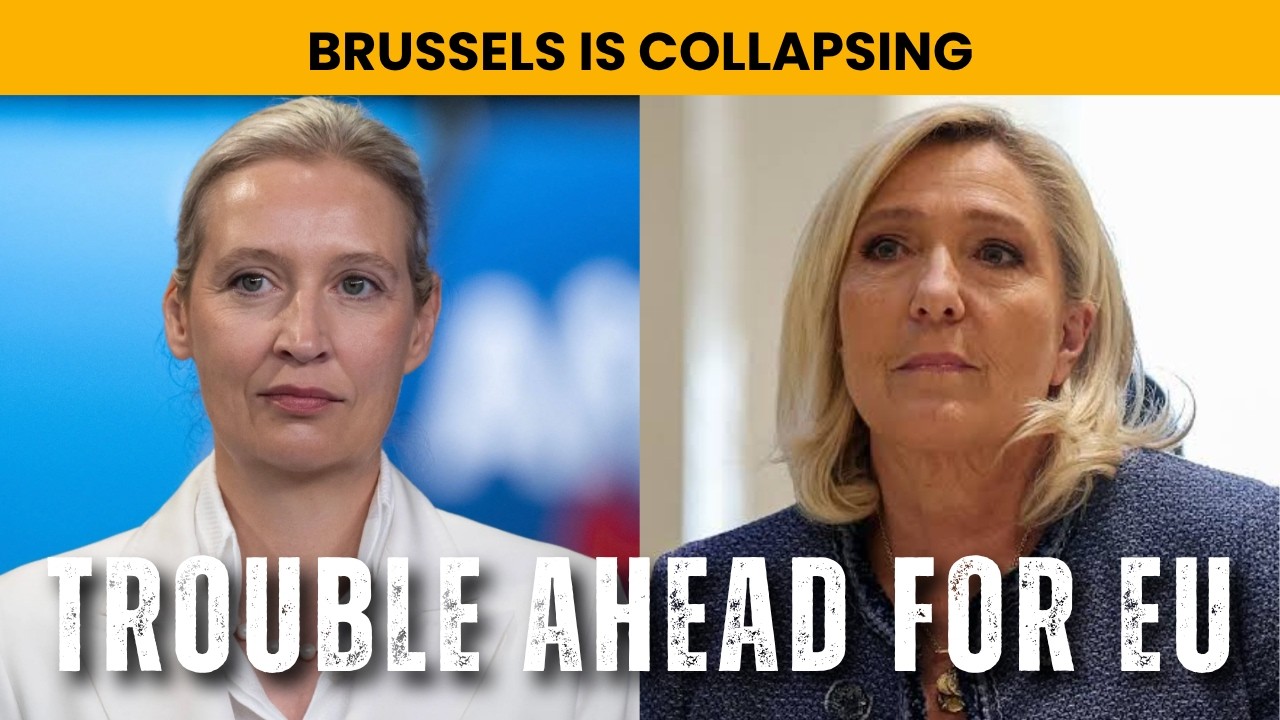
With the 2027 French presidential election approaching and Macron barred from running again, the hosts argue Marine Le Pen is breaking through: Mercouris calls the last parliamentary elections deeply rigged by a Macronist-leftist deal, says the left is shattered beyond recovery around Mélenchon, and puts Le Pen about 20% ahead of her main competitor — the only French politician worth taking seriously, with a de Gaulle-style sense of inevitability gathering around her. Asked to place her on the globalist spectrum, he puts her closer to Orban than to Meloni, driven by a coalition of the French working class and increasingly older voters, while noting she lacks Orban's brilliance, erudition, and consistency, and that she and Meloni 'can't stand each other'. Christoforou adds that 'Ursula has the tools, and she will use them' against her. On Germany, the hosts relay Alice Weidel's X post claiming about 43% support in East Germany — three times the CDU/CSU — and Mercouris rates Weidel a much more talented political leader and stronger intellectual figure than Le Pen, predicting the AfD will come first in Saxony-Anhalt, Saxony, and Mecklenburg-Western Pomerania. His travel impressions sharpen the picture: small towns carry on, but Mainz shows homeless people in the main square — unseen in Germany ten years ago — plus closing businesses, fading hostility to the AfD even in the West, and not one good word about Chancellor Merz among the people he spoke with; the AfD now looks to him like by far the strongest party in the country. The episode closes with Brussels, where Mercouris spent two days: the center is rapidly declining into 'a poor, increasingly run-down version' of a third-world city while the EU hangs a top-to-bottom 'This is democracy' banner on the Berlaymont and rebuilds the surrounding squares — in his reading, to prevent protests — with huge corruption said to run through it all. Belgium's leaders, he argues, live in an increasingly fortified bubble with deep contempt for the people around them. The closing contrast is a 'duel between two capitals': Moscow shining and efficient, Brussels turning into a slum.
Chapters & Key Takeaways
6 takeawaysLe Pen is presented as the only French politician worth taking seriously, about 20% ahead of Mélenchon in the presidential polls, with a de Gaulle-style inevitability beginning to take root — though the speaker allows everything may look different in three months.
The mechanism that will define a Le Pen presidency is her electoral coalition — the working class of France plus, an important change, increasingly older voters — which will push her closer to Orban than to Meloni, even though she lacks Orban's brilliance, strength of personality, and consistency.
Weidel is rated a much more talented political leader and stronger intellectual figure than Le Pen; the AfD is sweeping East Germany and is predicted to come first in the upcoming Saxony-Anhalt, Saxony, and Mecklenburg-Western Pomerania elections.
First-hand travel impressions: Mainz shows signs of economic disaster — homeless in the main square, something not seen in Germany ten years ago — hostility to the AfD has faded even in West Germany, and among the people he spoke to no one said a single good word about Chancellor Merz.
Brussels' center decays around a fortress EU quarter: a top-to-bottom 'This is democracy' banner on the Berlaymont, architecture rebuilt to prevent protests, and — per a Commission employee — endless construction soaked in huge corruption beyond the Ukraine project.
The episode's closing frame: what is happening in Europe is a duel between two capitals — Moscow a shining, ultra-modern, efficient metropolis, Brussels turning into a horrible slum.
Deep Read
Why Le Pen and Weidel Look Unstoppable, and What Tools the EU Still Has
The Duran builds this episode around a collision: a French presidential election in 2027 that Macron cannot contest, a German opposition party whose leader claims three-to-one dominance in the East,…
Read the full articleInterview Highlights
3 exchanges- Q
On the globalist spectrum, would you place Le Pen closer to Orban or to Meloni?
Alex Christoforou asked06:47AAlexander Mercouris answeredMercouris puts Le Pen closer to Orban than to Meloni, but without Orban's brilliance, strength of personality, or erudition, and without his consistency of thinking. He separates Le Pen as a political force from Le Pen as a politician: as a politician she has constantly dodged and changed her position. What pushes her toward Orban is her electoral coalition — the working class of France and, an important change, increasingly older voters, who were traditionally the most hostile to her and are now coming around to her side. That coalition will push her in a direction closer to Orban than to Meloni. On foreign policy, he says there has always been a view in France that the country became too close to the Americans and too close to the British under Macron, under Sarkozy, under Hollande.
- Q
Is the AfD really that serious a force, with its 20% support in East Germany?
Alex Christoforou asked11:17AAlexander Mercouris answeredMercouris thinks so, and says the more revealing comparison for Le Pen is Alice Weidel, whom he calls a much more talented political leader and a much stronger intellectual figure than Le Pen. The AfD is sweeping away everything in its path in East Germany, which has always been its main stronghold. He expects it to perform very strongly in the upcoming Saxony-Anhalt and Saxony elections and probably come in first, and says it will be first, he is sure, in Mecklenburg-Western Pomerania, which is also in East Germany.
- Q
Aren't the political leaders of Belgium and Brussels concerned about Brussels' decline?
Alex Christoforou asked20:23AAlexander Mercouris answeredMercouris argues they live in a bubble, an increasingly fortified one: they are well protected, are taking steps to protect themselves even more, and feel a deep contempt for the people around them — he does not think they have any love for the people of Brussels. Drawing on his own visits to the Commission since the 1990s, he says the people who worked there were always very disconnected from life in Belgium and Brussels, and that it has now reached a terrifying scale. A Commission employee told him the construction and redevelopment around the EU quarter seems to never end, and he says huge corruption is involved — beyond the scam around the Ukraine project there are other small deals in parallel.